ANERIS at EGI2026: Bringing Operational Marine Biology to Europe Digital Research Infrastructure Community

Between 21-25 September 2026, our team joined the EGI2026 conference in Ghent, Belgium.

Between the 21st and the 25th of September 2026, the ANERIS project, joined the EGI2026 Conference in Ghent, Belgium, as an exhibitor and conference partner.

Group photo EGI 2026
Group photo provided by EGI Foundation


Every year, the EGI Conference brings together digital and research infrastructure providers, data scientists and innovators to advance data-intensive science. Organised by the EGI Foundation in collaboration with partners from the EGI Federation, this year’s edition took place at the Bijloke, a former hospital site turned arts and knowledge campus on the banks of the river Lys. The five-day programme covered topics ranging from AI for European science and the European Open Science Cloud (EOSC) to federated compute and data infrastructures for research.

For ANERIS, the conference was a natural fit as the EGI Foundation is one of the project’s 25 partners, and the project’s vision of faster, more reliable and accessible marine life data depends directly on the kind of digital infrastructure discussed in Ghent.
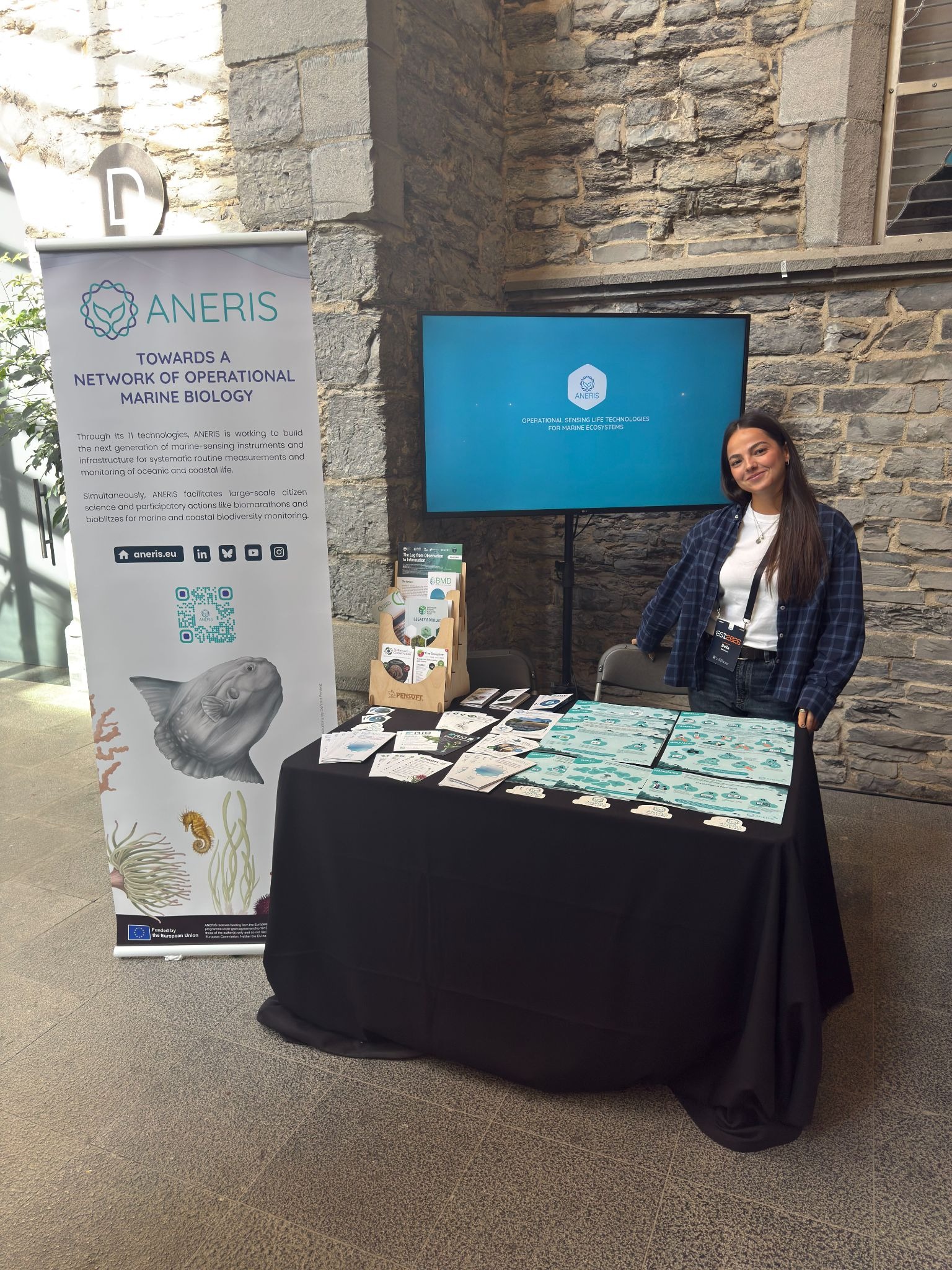
A person behind a stand
ANERIS booth at EGI2026 in Ghent.

During the opening ceremony, all exhibitors were invited to present their projects and initiatives to the audience in short pitches. Pensoft’s Communication Officer Bella Dimitrova used the opportunity to introduce ANERIS and its concept of Operational Marine Biology. Many attendees later came by the booth specifically to learn more about the project.

ANERIS materials
ANERIS materials.

The ANERIS booth welcomed a steady stream of visitors. Although most participants came from engineering and computing backgrounds, the project’s scientific illustrations and sticker sheets quickly became a highlight of the exhibition. The marine species featured on the stickers are among the most frequently observed and photographed during ANERIS citizen science campaigns. This made them a natural starting point for conversations about how volunteers, researchers and new technologies work together to monitor coastal biodiversity. Visitors also showed strong interest in the project’s newly produced case study factsheets and infographics, which made their print debut at the conference.

  • paper materials
  • paper materials
  • paper materials

At the booth, attendees could also learn more about Pensoft’s expertise and experience as a scientific publisher through a selection of journals aligned with the conference themes. They could also find out about Pensoft’s role as an active consortium member in the COAST-SCAPES, B-Cubed and Biodiversity Meets Data projects.   

Funded by the European Union’s Horizon Europe programme and coordinated by the Institute of Marine Sciences (ICM-CSIC), ANERIS brings together 25 partners from 13 countries. Over four years, the consortium has developed 11 technologies for marine life sensing and monitoring. They cover AI-assisted imaging of plankton and macrofauna, genomic and eDNA approaches and citizen science observatories such as MINKA.

As the project nears its end in December 2026, the focus is on making these tools usable beyond the project’s lifetime. This includes integrating them into European research infrastructures, which is why conversations with the EGI community were especially valuable. Combining large-scale imaging data, AI-based identification and citizen observations requires reliable storage, compute and data services. These are exactly the services EGI2026 participants build and operate.

The project’s results will be further showcased at the ANERIS Final Workshop “The future of marine monitoring – imaging, AI, and research infrastructures” on the 16th of November 2026. The hybrid event will be hosted by VLIZ in Oostende, Belgium. Through real-world case studies, partners will present tools including AI-driven underwater image restoration, automated organism identification platforms and integrated citizen science observatories. Shortly after, ANERIS will also take part in the 7th World Conference on Marine Biodiversity in Bruges.

The full plenary recordings and the detailed programme are available on the conference’s official website. 

Striking New Precious Coral Species Found off the Coast of Kochi Prefecture, Japan

The scientific name of the new species, Hemicorallium osmanthogemmum, has a beautiful meaning rooted in botany.

Marine researchers have identified a vibrant new species of deep-sea precious coral off the coast of Kochi Prefecture, Japan. The new species, named Hemicorallium osmanthogemmum, was described by Tatsuki Koido from the Kuroshio Biological Research Foundation and published in the open-access journal ZooKeys.

The specimen was originally brought to the surface after being incidentally hooked at a depth of approximately 550 metres off Cape Ashizuri during longline fishing operations for alfonsino fish. Recognising its unique characteristics, the collector deposited the specimens at the Kuroshio Biological Research Foundation for further study.

Through microscopic examination of the coral’s tiny skeletal structures (called sclerites) combined with advanced multi-gene DNA analysis, the coral was confirmed to be entirely new to science, marking the first time the deep-sea genus Hemicorallium has ever been reported off Kochi Prefecture.

Scanning electron micrograph of sclerites of Hemicorallium osmanthogemmum sp. nov. Image credit: Tatsuki Koido.

Resembling Sweet Olive Buds: The Etymology

The scientific name of the new species, Hemicorallium osmanthogemmum, has a beautiful meaning rooted in botany. The specific name is derived from Osmanthus (the plant genus containing the sweet olive tree) and the Latin word gemma, meaning “bud”. This name highlights a distinct physical trait of the coral: its large polyp mounds are tightly clustered together at the very tips of its branches, mirroring the appearance of flower buds on a sweet olive tree.

Reflecting this resemblance, the coral has been given the new Japanese common name Kinmokusei-mizo-sango, which translates to “sweet olive groove-coral”. In life, the coral features a striking contrast of colours; its outer living tissue is a vibrant orange, while its solid internal skeletal axis is a stunning shade of pink.

Hemicorallium osmanthogemmum sp. nov. Surface detail of branch. Image credit: Tatsuki Koido.

The Cultural and Environmental Value of Precious Corals

Precious corals, which primarily belong to the family Coralliidae, have been highly valued by humans for centuries. Because they possess solid inner skeletons and vivid natural colouration, they are traditionally sought after globally for crafting fine jewellery and ornaments.

In recent years, however, the global perspective has shifted significantly. Instead of viewing precious corals solely through the lens of resource consumption, modern marine science is focused heavily on developing innovative methods for propagation and active population replenishment.

Japan has a particularly deep history in this field; domestic scientific study of precious corals began in the early 20th century, and discussions regarding resource conservation through coral release programmes date back more than one hundred years, showing a long-standing cultural and scientific dedication to the sustainable management of the precious coral industry.

Hemicorallium osmanthogemmum sp. nov. ‘Front’’ and ‘‘back’’ of colony. Image credit: Tatsuki Koido.

Why This Discovery Matters

Corals in the genus Hemicorallium live in particularly deep waters where environmental sampling is extremely challenging, therefore opportunities to study them are rare. Marine biologists believe that many more undiscovered species are still hidden across these deep seafloors.

Original Study:

Koido T (2026) A new species of Hemicorallium (Anthozoa, Octocorallia, Coralliidae), along with a revised identification key to species of the genus. ZooKeys 1277: 339-354. https://doi.org/10.3897/zookeys.1277.184620

For more articles on zoology, visit the ZooKeys website and follow the journal on BlueSky and Facebook.

Tiny sesame sea slug species discovered in the waters of northern Taiwan

This tiny nudibranch, which measures less than three millimetres in length, was first spotted by lead author Ho-Yeung Chan during a recreational dive in 2019.

Translucent, speckled, and barely the size of a grain of rice, a new species of sea slug has been identified in the coastal waters of Keelung, Taiwan. Because of its minute size and distinctive black and yellow markings, researchers from National Taiwan Ocean University, National Museum of Natural Science and National Taipei University of Education have named the creature Thecacera sesama.

“Taiwanese divers call it ‘sesame’ in Chinese and it is also small like a sesame seed, hence the name,” the research team explained regarding their decision to honour the local nickname in the scientific nomenclature. This tiny nudibranch, which measures less than three millimetres in length, was first spotted by lead author Ho-Yeung Chan during a recreational dive in 2019.

Thecacera sesama sp. nov. Details of appearance and morphological features, hand-drawn on a tablet PC by Chen-Lu Lee. 

The discovery was a stroke of luck that began during Chan’s undergraduate studies:

“During a recreational dive in the summer during the undergraduate study of HY Chan in 2019, he accidentally discovered Thecacera sesama sp. nov. in northern Taiwan waters.”

The Research Team

Despite its unique appearance, the importance of the find was not immediately obvious. In a modern twist on traditional taxonomy, Chan “never realised Thecacera sesama was a new species until he consulted the sea slug expert ‘Hsini Lin teacher’ on Facebook.”

Living specimens of Thecacera sesama sp. nov. Image credit: Ho-Yeung Chan et al.

Documenting the species proved to be a significant logistical feat due to the volatile environment of the Keelung coast. The research team noted that the most challenging part of the study was the unique weather conditions of the region.

Taiwan experiences frequent typhoons in the summer and large waves during the winter monsoon season, with sea temperatures often dropping below 16 degrees Celsius. These factors mean that diving for nudibranch research is only possible for about four months of the year, making sightings of such tiny creatures entirely a matter of chance.

Living specimens of bryozoan with Thecacera species. Image credit: Ho-Yeung Chan et al.

The life of T. sesama is remarkably focused, as the researchers observed that the species exhibits only four primary behaviours: feeding, searching, mating, and laying eggs on bryozoans, which are tiny aquatic invertebrates often called “moss animals”. Interestingly, the specific bryozoan that T. sesama calls home may itself be a species new to science.

From a broader ecological perspective, these vibrant molluscs play a vital role in the marine environment:

“Nudibranchs are one of the key players in the marine food web. They are extremely colourful and can be spotted on coral reef ecosystems. However, many nudibranchs are very small in size and are extremely difficult to spot underwater with the naked eye.”

The Research Team

The researchers believe that the discovery of T. sesama is just the tip of the iceberg for Taiwanese marine biology. Because many species are so small, many more are likely awaiting discovery and formal study. The full research on Thecacera sesama was published in the open-access journal ZooKeys on 11 May 2026.

Original source:

Chan H-Y, Lee C-L, Chen W-C, Chang C-H, Shao Y-T, Pang K-L (2026) Thecacera sesama sp. nov. (Nudibranchia, Polyceridae) from Taiwan, evident from morphology and phylogenetic analyses of the 16S rDNA and cytochrome c oxidase I gene. ZooKeys 1279: 269-284. https://doi.org/10.3897/zookeys.1279.184298

Cover image:

Two individuals of Thecacera sesama sp. nov. feeding on a bryozoan. Image credit: Ho-Yeung Chan et al.

For more interesting articles on zoology, follow ZooKeys on Facebook and Bluesky.

The Giants of the Reef: New Citizen Science Project Races to Document Centennial Corals

Ancient, massive coral reef colonies hold scientific treasures but remain largely unknown – now they are being mapped with the help of citizen science.

Guest blog post by Federica Siena

Coral reefs hide “scientific treasures” that have survived for centuries, yet many of these giant, ancient organisms remain largely unknown to science. A new study published in the journal Nature Conservation introduces “Map the Giants,” a pioneering citizen-science initiative launched by researchers from the University of Milano-Bicocca to find these giant coral colonies before they are lost to escalating global pressures.

Map the Giants® was born from a sobering yet stimulating realization by the research team: despite their centennial age and their remarkable sizes – defined by the project as colonies measuring at least 5 meters in length – these colonies lack formal recognition. This leaves them vulnerable to disappearance simply because we do not know they exist.

A Mission of Discovery

Coral giant, video credit to Map the Giants®

While these coral giants have withstood the elements for hundreds of years, the last century has brought unprecedented local and global threats. “We are in a race to recognize these organisms. They have survived for centuries, but modern pressures are increasing so rapidly that some colonies may disappear before they are even documented,” the authors emphasized the urgency.

The research highlights that identifying these giants is not just a scientific necessity, but a vital tool for fostering ocean literacy and raising awareness among local stakeholders and the broader community – a goal made possible through a standardized reporting protocol and multi-expert validation that ensures robust data collection regardless of the contributor’s background.

Secrets of Survival

The team searched for more than just size; they also looked for vital clues to “coral resilience“. Long-lived giant corals act as high-resolution time capsules, archiving centuries of past climate and environmental conditions within their skeletons.

By locating and studying these ancient survivors, we hope to unlock the genetic secrets and traits that have enabled these specific individuals to resist and acclimatize to environmental changes.

researchers explained

Furthermore, the project aims to provide a validated sampling frame to support peer-reviewed studies on resilient “super-corals,” which could help future-proof and restore the reefs of tomorrow. Ultimately, by identifying these culturally and ecologically valuable colonies, the researchers plan to collaborate with stakeholders to explore protection measures and establish them as marine monuments.

The Power of the Community

@pensoft.publishers

Some #corals have been alive for CENTURIES – and scientists are just now racing to find them before they disappear. 🪸 “Map the Giants” is a new citizen science project tracking coral colonies 5+ metres long. In just 18 months, contributors from 22 countries have already added 133 verified entries to the global database. 👐Pretty incredible what a community can do. Photo and video credit to: Map the Giants, Luca Fallati, Federica Siena, Anuar Abdulla and Easy Divers Bali #coralreefs #science #marine #climatechange

♬ mirage – théos & Antent

The project has already seen remarkable success. In its first 18 months, the initiative received 195 submissions from 22 countries, resulting in 133 validated entries added to the public database. Most surprisingly, the project reports of an incredibly large Porites sp. coral measuring over 60 metres in linear length or a Pavona cf. clavus over 195 metres in perimeter, offering new inspirations for future scientific research.

Citizen science is pivotal. The sheer scale of coral reefs requires a concerted effort. Anyone with a camera and a snorkel can join us. A simple report of a giant’s existence is the first step in recognizing and studying them.

said the project lead Prof. Simone Montano

How to Join the Search

The project is designed for total accessibility. Through a dedicated website (www.mapthegiants.com) and social media presence, the public can contribute data and learn about the beauty and fragility of reef ecosystems. The adaptable protocol ensures that whilst data are robust, the background of the contributor will only affect the level of complexity of the data, not the report on its own. By turning divers and reef users into “coral seekers,” the project aims to bridge the gap between professional science and community-led conservation.

Original source:

Siena FM, Gabbiadini A, Fallati L, Galli P, Montano S (2026) Map the Giants: a new citizen-science portal to map, study and protect the largest coral colonies. Nature Conservation 63: 127-151. https://doi.org/10.3897/natureconservation.63.182923

New Michelin Star Jellyfish Discovered in Japanese Aquaria

Malagazzia michelin is only the second species of its genus to be found in Japanese waters.

Researchers have reported the discovery of a new species of jellyfish, Malagazzia michelin, marking only the second species of its genus ever found in Japanese waters. Led by Takato Izumi of Fukuyama University, the discovery was a collaborative effort between marine biologists and staff from several prominent institutions, including the Tsuruoka City Kamo Aquarium and the Saikai National Park Kuju-kushima Aquarium. The full study is published in the open-access journal ZooKeys.

First spotted in the shallow waters of Nagasaki and Yamaguchi Prefectures, the Malagazzia michelin jellyfish has subsequently been cultured and studied in captivity, providing scientists with a complete look at its entire life cycle from polyp to adult.

Sampling localities of Malagazzia michelin. A. Tabira and Sasebo, Nagasaki Pref. (indicated by black stars); B. Katasoe-ga-hama, Yamaguchi Pref. (by grey star). (Image credit: Izumi et al.).

A Unique Marine Resident

Malagazzia michelin is a small aquatic invertebrate characterised by a hemispherical, transparent umbrella that typically grows to between 12 and 20 millimeters in diameter. While it shares the four-lipped mouth and linear gonads typical of its genus, it is easily distinguished by a peculiar feature: enigmatic brown spots that resemble tiny oil droplets scattered across its reproductive organs and central stomach. DNA analysis has confirmed its status as a unique species, which is distinct from other known members of the Malagazzia family.

Enlarged view of the structures of living Malagazzia michelin. A, B. Closed lips; C. Open lips; D. Tentacles and tentacular bulbs; E–G. Gonads; F. Mature female; G. Mature male. Scale bar: 0.1 mm. (Image credit: Izumi et al.).

The species has been aptly named Malagazzia michelin as a playful nod to the famous Michelin Guide. As the jellyfish matures, the number of its distinctive brown spots increases, a process that researchers likened to a restaurant earning more “stars” for its quality. This celestial theme is also reflected in its new Japanese common name, ama-no-gawa-kurage (Milky Way jellyfish), which compares the white gonads and twinkling brown spots to a starry galaxy.

External view of the living medusae of Malagazzia michelin. A. Lateral view; B. Oral view; C. Lateral view of Kuju-kushima 3 with lighting; D–F. Kuju-kushima 1; D. Aboral view; E. Sketch from aboral side; F. Lateral view. Scale bar: 5 mm. (Image credit: Izumi et al.).
Polyps and juvenile–young medusae of Malagazzia michelin. A. Development of juvenile medusae; B–E. Polyps. Scale bar: 1 mm (thick); 200 µm (slender). (Photo credit: Izumi et al.).

Navigating the Confusion of Common Names

The formal scientific description of M. michelin addresses an interesting challenge in Japanese marine biology: the risk of common names. In Japan, ornamental jellyfish are often given descriptive common names, such as “salmon-roe laodicean jellyfish” (tsubuiri-sujiko-yawara-kurage), long before they are scientifically identified. This can lead to confusion – M. michelin, for instance, was previously misidentified in field guides as a member of the Laodicea genus, which is not closely related. Researchers emphasise that formal taxonomic work is essential to ensure that the biodiversity displayed in aquaria is accurately documented.

The discovery of Malagazzia michelin demonstrates the significant role that aquariums play as centres for scientific research and biodiversity discovery. By strengthening ties between public exhibitions and taxonomic research, scientists continue to bring the ocean’s most stellar species to light.

Original source:

Izumi T, Ikeda S, Nozoe Y, Goto S, Imamura N, Kinoshita T, Uchida H, Hamatsu Y, Akiyama H, Okuizumi K (2026) Discoveries from ornamental jellyfish in aquaria—description of Malagazzia michelin sp. nov. (Cnidaria, Hydrozoa, Leptothecata), second species of the genus from Japan. ZooKeys 1268: 13-32. https://doi.org/10.3897/zookeys.1268.173354

For more articles on zoology, visit the ZooKeys website and follow the journal on BlueSky and Facebook.

First-ever fish species described by a Maldivian scientist

Though there are hundreds of species of fish found off the coast of the Maldives, a mesmerizing new addition is the first-ever to be formally described by a Maldivian researcher.

Named after the country’s national flower, the species is added to the tree of life as part of the California Academy of Sciences’ global Hope for Reefs initiative

Originally published by the California Academy of Sciences

Though there are hundreds of species of fish found off the coast of the Maldives, a mesmerizing new addition is the first-ever to be formally described—the scientific process an organism goes through to be recognized as a new species—by a Maldivian researcher.

The new-to-science Rose-Veiled Fairy Wrasse (Cirrhilabrus finifenmaa), described in the journal ZooKeys, is also one of the first species to have its name derived from the local Dhivehi language, ‘finifenmaa’ meaning ‘rose’, a nod to both its pink hues and the island nation’s national flower.

Scientists from the California Academy of Sciences, the University of Sydney, the Maldives Marine Research Institute (MMRI), and the Field Museum collaborated on the discovery as part of the Academy’s Hope for Reefs initiative aimed at better understanding and protecting coral reefs around the world.

“It has always been foreign scientists who have described species found in the Maldives, even those that are endemic, without much involvement from local scientists. This time, it is different and getting to be part of something for the first time has been really exciting, especially having the opportunity to work alongside top ichthyologists on such an elegant and beautiful species,”

says study co-author and Maldives Marine Research Institute biologist Ahmed Najeeb.

First collected by researchers in the 1990s, C. finifenmaa was originally thought to be the adult version of a different species, Cirrhilabrus rubrisquamis, which had been described based on a single juvenile specimen from the Chagos Archipelago, an island chain 1,000 kilometers (621 miles) south of the Maldives. 

In this new study, however, the researchers took a more detailed look at both adults and juveniles of the multicolored marvel, measuring and counting various features, such as the color of adult males, the height of each spine supporting the fin on the fish’s back and the number of scales found on various body regions. These data, along with genetic analyses, were then compared to the C. rubrisquamis specimen to confirm that C. finifenmaa is indeed a unique species. 

Importantly, this revelation greatly reduces the known range of each wrasse, a crucial consideration when setting conservation priorities.  

“What we previously thought was one widespread species of fish, is actually two different species, each with a potentially much more restricted distribution. This exemplifies why describing new species, and taxonomy in general, is important for conservation and biodiversity management,”

says lead author and University of Sydney doctoral student Yi-Kai Tea. 

Despite only just being described, the researchers say that the Rose-Veiled Fairy Wrasse is already being exploited through the aquarium hobbyist trade. 

“Though the species is quite abundant and therefore not currently at a high risk of overexploitation, it’s still unsettling when a fish is already being commercialized before it even has a scientific name. It speaks to how much biodiversity there is still left to be described from coral reef ecosystems,”

says senior author and Academy Curator of Ichthyology Luiz Rocha, PhD, who co-directs the Hope for Reefs initiative.

Last month, Hope for Reefs researchers continued their collaboration with the MMRI by conducting the first surveys of the Maldives’ ‘twilight zone’ reefs—the virtually unexplored coral ecosystems found between 50- to 150-meters (160- to 500-feet) beneath the ocean’s surface—where they found new records of C. finifenmaa along with at least eight potentially new-to-science species yet to be described. 

This new-to-science Rose-Veiled Fairy Wrasse (Cirrhilabrus finifenmaa) became the first Maldivian fish to ever be described by a local researcher.
Photo by Yi-Kai Tea.

For the researchers, this kind of international partnership is pivotal to best understand and ensure a regenerative future for the Maldives’ coral reefs. 

“Nobody knows these waters better than the Maldivian people. Our research is stronger when it’s done in collaboration with local researchers and divers. I’m excited to continue our relationship with MMRI and the Ministry of Fisheries to learn about and protect the island nation’s reefs together,”

says Rocha says

“Collaborating with organizations such as the Academy helps us build our local capacity to expand knowledge in this field. This is just the start and we are already working together on future projects. Our partnership will help us better understand the unexplored depths of our marine ecosystems and their inhabitants. The more we understand and the more compelling scientific evidence we can gather, the better we can protect them,”

adds Najeeb.

***

Research article:

Tea Y-K, Najeeb A, Rowlett J, Rocha LA (2022) Cirrhilabrus finifenmaa (Teleostei, Labridae), a new species of fairy wrasse from the Maldives, with comments on the taxonomic identity of C. rubrisquamis and C. wakanda. ZooKeys 1088: 65-80. https://doi.org/10.3897/zookeys.1088.78139

***

Follow ZooKeys on Twitter and Facebook.

Celebrating Taxonomist Day with Elvis Worms and Sneaky Pipefish

Happy Taxonomist Appreciation Day! On this day dedicated to the scientists who name, define and classify all living things, the World Register of Marine Species (WoRMS) also honors discoveries in marine biology by posting a “Top 10” of the marine species discovered throughout the year. The year 2020 saw fascinating discoveries in the world of sea life, and, once more, species first described in Pensoft‘s open-access journal ZooKeys made it to the Top 10!

The Fabulous, Rowdy Elvis Worm   

The sparkliest entry in this year’s Top 10, and arguably the most glamorous deep-sea animal discovered in 2020, is undoubtedly a scale worm described in ZooKeys by scientists of the University of California San Diego, the French National Centre for Scientific Research and Sorbonne University.

Peinaleopolynoe orphanae

Deep in the Pacific Ocean, researchers found not one, not two, but four species of iridescent scale worms. They have yet to figure out why these critters shimmer, but the Internet was already calling them ‘Elvis worms’ or ‘glitter worms’, because their scales evoked associations with Elvis’ shiny costumes. One species was even formally named Peinaleopolynoe elvisi in honor of the King of Rock ‘n’ Roll.

https://twitter.com/RebeccaRHelm/status/1260652701907447814

It was however one of the other three species, Peinaleopolynoe orphanae, that made it to the Top 10 –  because, in the words of the committee, it has “both the most stunning iridescence and the feistiest temperament!”

P. orphanae was first collected from a hydrothermal vent in the Gulf of California at a depth of 3700 m and named after geobiologist Victoria Orphan. The first part of its name, Peinaleopolynoe, comes from a Greek word for hungry, in reference to the attraction of these worms to food falls.

Surprisingly, Peinaleopolynoe orphanae engage in fights between each other before the eyes of the researchers! In what has never been seen in scale worms before, the scientists recorded a “face-off”, where two individuals kept attacking one another back and forth for several minutes.

The Red Pipefish, Master of Disguise

The Red Wide-Bodied Pipefish (Stigmatopora harastii) dwells in New South Wales, Australia, at 10-25 m depth, and is so good at camouflage that you might have a hard time spotting it even when you’re looking straight at it. It was first reported by underwater photographers in Jervis Bay in 2002, but was only described as a new species in 2020 by scientists from the Australian Museum, California Academy of Sciences, Burke Museum, and the University of British Columbia.

This curious new fish associates with red algae or finger sponges, which allows it to stay hidden in plain sight. It is colored bright red, but curiously that only helps it to go unnoticed. Oriented vertically or at an angle, it camouflages itself among the red algae. Virtually indistinguishable from its surroundings, it only occasionally darts out of its cozy cover to munch on small copepods and shrimp.

Stigmatopora harastii

Stigmatopora harastii was named after David Harasti, one of the first people to recognize it as a new species and a pronounced fan of the Stigmatopora genus. According to the research paper, “David has stated he counts green pipefish to fall asleep.” We don’t know how he feels about red pipefish, but this one charms with both looks and skills, so we hope it becomes one of his favorites.

Stigmatopora harastii

Researchers believe the red pipefish might have a wider distribution in New South Wales and possibly New Zealand – it can be very hard to detect because of its preferred depth range and its remarkable camouflaging ability.

The 10 remarkable new marine species from 2020 listed by WoRMS are a celebration of all wonderful and sometimes even quite weird creatures that dwell in the sea, and a reminder of how important it is to explore and protect marine life. Here’s to another year of fun little creatures and amazing scientific discoveries!

Failure to respond to a coral disease epizootic in Florida: causes and consequences

By 2020, losses of corals have been observed throughout Florida and into the greater Caribbean basin in what turned out to be likely the most lethal recorded case of Stony Coral Tissue Loss Disease. A Perspectives paper, published in the open-access peer-reviewed journal Rethinking Ecology, provides an overview of how Florida ended up in a situation, where the best that could be done is rescuing genetic material from coral species at risk of regional extinction.

Guest blog post by William F. Precht

A colony of the large grooved brain coral, Colpophyllia natans, infected by Stony Coral Tissue Loss Disease. The photo shows the progressive, rapid advance of disease, left-to-right, across the colony.
Image by William Precht.

Dredging projects conducted in association with coral reefs typically generate concern by environmental groups, resulting in careful monitoring by government agencies. Even though the aim of those dredge projects is to widen or deepen existing ship channels, while minimizing damage to coral reef resources, there are often the intuitive negative assumptions that dredging kills corals.

The recent Port Miami Dredge Project started as an uncomplicated case story. However, significant problems arose, caused by a concurrent and unprecedented coral disease epidemic that killed large numbers of corals, which was initiated following a regional thermal anomaly and coral bleaching event.

The coral disease, known as Stony Coral Tissue Loss Disease (SCTLD), was first observed in September 2014 near Virginia Key, Florida. In roughly six years, the disease has spread throughout Florida and into the greater Caribbean basin. The high prevalence of SCTLD and the resulting high mortality in coral populations, coupled with the large number of susceptible species affected, suggest that this disease outbreak is one of the most lethal ever recorded on contemporary coral reefs. The disease is still presently active and continues to ravage coral reefs throughout the region.

The initial response to this catastrophic disease by resource managers with purview over the ecosystem in Southeast Florida was slow. There is generally a noticeably short window of opportunity to intervene in disease amelioration or eradication in the marine environment. This slow response enabled the disease to spread unchecked. Why was the response to the loss of our coral reefs to a coral disease epidemic such a massive failure? This includes our failure as scientists, regulators, resource managers, local media, and policy makers alike. With this Perspectives paper, published in Rethinking Ecology, my intention was to encapsulate the numerous reasons for our failures during the first few years of the outbreak, reminiscent of the early failures in the U.S. response to the COVID-19 pandemic.

First, the Port Miami dredging project was ongoing when the coral disease epidemic began. Some managers and local environmental groups blamed dredging, rather than SCTLD for the coral losses, reported in the project’s compliance monitoring program. Second, this blame was amplified in the media, because dredging projects are intuitively assumed to be bad for coral reefs. Third, during this same time, the State of Florida prohibited government employees from acknowledging global warming in their work. This was problematic because ocean warming is a proximal cause of many coral diseases.

As a result, some managers ignored the well-known links between warming and coral disease. A consequence of this policy was that the dredging project provided an easy target to blame for the coral mortality noted in the monitoring program, despite convincing data that suggested otherwise. 

Specifically, the intensive compliance monitoring program, conducted by trained scientific divers, was statistically significant. SCTLD that was killing massive numbers of corals throughout the region was also killing corals at the dredge site. Further, this was happening in the same proportions and among the same suite of species. 

Finally, when the agencies responded to the outbreak, their efforts were too little and much too late to make a meaningful difference. While eradication of the disease was never a possibility, early control measures may have slowed its spread, or allowed for the rescue of significant numbers of large colonies of iconic species. Because of the languid management response to this outbreak, we are now sadly faced with a situation where much of our management efforts are focused on the rescue of genetic material from coral species already at risk of regional extinction.

The delayed response to this SCTLD outbreak in Southeast Florida has many similarities to the COVID-19 pandemic response in the United States and there are lessons learned from both that will improve disease response outcomes in the future, to the benefit of coral reefs and human populations.

Publication:

Precht W (2021) Failure to respond to a coral disease epizootic in Florida: causes and consequences. Rethinking Ecology 6: 1-47. https://doi.org/10.3897/rethinkingecology.6.56285

Notice me! Neglected for over a century, Black sea spider crab re-described

After the revision of available type specimens from all available collections in the Russian museums and the Senckenberg Museum in Frankfurt-on-Main, as well as newly collected material in the Black Sea and the North-East Atlantic, a research team of scientists, led by Dr Vassily Spiridonov from Shirshov Institute of Oceanology of Russian Academy of Sciences, re-described Macropodia czernjawskii and provided the new data on its records and updated its ecological characteristics.

Even though recognised in the Mediterranean Sea, the Macropodia czernjawskii spider crab was ignored by scientists (even by its namesake Vladimir Czernyavsky) in the regional faunal accounts of the Black Sea for more than a century. At the same time, although other species of the genus have been listed as Black sea fauna, those listings are mostly wrong and occurred either due to historical circumstances or misidentifications.Now, scientists re-describe this, most likely, only species of the genus occurring in the Black Sea in the open-access journal Zoosystematics and Evolution.

The studied spirder crab species Macropodia czernjawskii in the wild, Tuaphat (near Gelendzhik), Caucasus, Black Sea.
Photo by Sergey Anosov

The spider crab genus Macropodia was discovered in 1814 and currently includes 18 species, mostly occurring in the Atlantic and the Mediterranean. The marine fauna of the Black Sea is predominantly of Mediterranean origin and Macropodia czernjawskii was firstly discovered in the Black Sea in 1880, but afterwards, its presence there was largely ignored by the scientists.

After the revision of available type specimens from all available collections in the Russian museums and the Senckenberg Museum in Frankfurt-on-Main, as well as newly collected material in the Black Sea and the North-East Atlantic, a research team of scientists, led by Dr Vassily Spiridonov from Shirshov Institute of Oceanology of Russian Academy of Sciences, re-described Macropodia czernjawskii and provided the new data on its records and updated its ecological characteristics.

“The analysis of the molecular genetic barcode (COI) of the available material of Macropodia species indicated that M. czernjawskii is a very distinct species while M. parva should be synonimised with M. rostrata, and M. longipes is a synonym of M. tenuirostris”,

states Dr Spiridonov sharing the details of the genus analysis.

All Macropodia species have epibiosis and M. czernjawskii is no exception: almost all examined crabs in 2008-2018 collections had significant epibiosis. It normally consists of algae and cyanobacteria and, particularly, a non-indigenous species of red alga Bonnemaisonia hamifera, officially reported in 2015 at the Caucasian coast of the Black Sea, was found in the epibiosis of M. czernjawskii four years earlier.

“It improves our understanding of its invasion history. Museum and monitoring collections of species with abundant epibiosis (in particular inachid crabs) can be used as an additional tool to record and monitor introduction and establishments of sessile non-indigenous species,”

suggests Dr Spiridonov.
The spider crab species Macropodia czernjawskii in the wild, Tuaphat (near Gelendzhik), Caucasus, Black Sea.
Photo by Sergey Anosov

***

Original source:

Spiridonov VA, Simakova UV, Anosov SE, Zalota AK, Timofeev VA (2020) Review of Macropodia in the Black Sea supported by molecular barcoding data; with the redescription of the type material, observations on ecology and epibiosis of Macropodia czernjawskii (Brandt, 1880) and notes on other Atlanto-Mediterranean species of Macropodia Leach, 1814 (Crustacea, Decapoda, Inachidae). Zoosystematics and Evolution 96(2): 609-635. https://doi.org/10.3897/zse.96.48342