Genomic study uncovers a new lace bug species on Japan’s remote Ogasawara Islands

Analysing 52 specimens with a genetic method known as MIG-seq, the team found that an insect previously regarded as a single species, Omoplax desecta, in fact comprised two.

Researchers have used genome-wide DNA data to identify a new insect species on the Ogasawara Islands, a remote Japanese archipelago roughly 900 to 1,000 kilometres south of Tokyo. The findings suggest that evolution among island insects is more intricate than appearances imply. The study is published in the open-access journal ZooKeys.

The Ogasawara Islands are a UNESCO World Natural Heritage site, celebrated for their endemic land snails and plants. Their insects, of which some 440 endemic species are known, have received far less evolutionary attention.

Jun Souma, of Hirosaki University’s Shirakami Research Center for Environmental Sciences, and Naoyuki Nakahama, of the Graduate School of Agriculture at Osaka Metropolitan University, examined Omoplax, a genus of lace bugs found nowhere else and thought to have diversified rapidly across the islands.

Analysing 52 specimens with a genetic method known as MIG-seq, the team found that an insect previously regarded as a single species, Omoplax desecta, in fact comprised two. Populations on the Chichijima and Hahajima island groups were genetically distinct, and subtle differences in male genitalia confirmed the split. The Hahajima population is now described as Omoplax sandoru, named after the local name of its host plant.

Omoplax desecta (nymph). Image credit: Jun Souma.
Omoplax desecta (adult). Image credit: Jun Souma.

Souma was first drawn to Omoplax desecta by its unusual diet:

“The reason I took a particular interest in Omoplax desecta is that it feeds on both the native plant Rhaphiolepis indica var. tashiroi and the introduced plant Calophyllum inophyllum in the Chichijima island group.

This is quite unusual for lace bugs, which typically exhibit high host specificity. I was also intrigued by the fact that it is distributed across multiple island groups, which is different from other Omoplax species.”

The Hahajima population posed its own puzzle:

“I had wondered why it fed exclusively on Rhaphiolepis indica var. tashiroi and why there were no individuals with dark brown to black pronotum, which are sometimes seen in the Chichijima island group.

After conducting population genetic and phylogenetic analyses, I began to suspect that this population might be a distinct species. Upon closely observing their morphological characteristics, I was certain of this.”

Jun Souma, conducting observation on Calophyllum inophyllum where Omoplax desecta feeds. Image credit: Jun Souma.

The evolutionary tree also overturned expectations:

“The most surprising finding of my research was that species feeding on the same plant and appearing very similar are not necessarily sister groups.

Adaptive radiation among insects on oceanic islands may be more complex than comparisons of morphological characteristics and life histories would suggest at first glance.”

The results point to both geographic isolation and shifts between host plants as drivers of speciation.

Rhaphiolepis indica var. tashiroi. Image credit: Jun Souma.

Of particular interest is the insect’s adoption of Calophyllum inophyllum, a tree introduced by people. The data indicate that this host shift occurred once, and recently.

“I also find it interesting that the introduction of Calophyllum inophyllum by humans may have led to a budding of future speciation in Omoplax desecta.”

Jun Souma
Calophyllum inophyllum. Image credit: Jun Souma.

The authors note that DNA could not be obtained from two rare species, leaving parts of the story unresolved. Further sampling will be needed to trace how these insects reached the islands and diversified.

Original source:

Souma J, Nakahama N (2026) Genome-wide SNP data reveal phylogenetic relationships and further new species of lace bugs (Hemiptera, Heteroptera, Tingidae) endemic to the Japanese oceanic islands (the Ogasawara Islands), providing insight into their speciation. ZooKeys 1294: 175-203. https://doi.org/10.3897/zookeys.1294.205145


For more articles on zoology, visit the ZooKeys website and follow the journal on BlueSky and Facebook.

Three New Species of Conger Eel Discovered in the Deep Waters Around Taiwan

Researchers have now described three new species of the conger eel genus Gnathophis, drawing on 130 specimens collected from the deep sea.

Researchers from National Taiwan Ocean University, University of Taipei and the Smithsonian Institution have now described three new species of the conger eel genus Gnathophis, drawing on 130 specimens collected from the deep sea. The findings raise the number of Gnathophis species known from Taiwan from two to five.

Members of this genus are medium-sized eels of tropical and subtropical deep waters, recognisable by a blunt tail tip, a fleshy snout that projects beyond the teeth, and a small fleshy keel on the underside of the snout.

The team compared vertebral counts, the pores of the sensory lateral line, colouring and tooth patterns, and for two of the species they added DNA barcoding to confirm the distinction. The two barcoded species differ from each other by roughly 4.4 to 4.9 per cent in the gene examined, well beyond the variation seen within a single species.

Each name tells a small story about where the eel was found or how it looks:

  • Gnathophis kbalanensis (Kbalan’s conger): named after “Kbalan”, an ancient name for the Yilan region of northeastern Taiwan, in use roughly 800 to 1,300 years ago. It is also known as Cabaran in Spanish and Kat-má-lán in Taiwanese. The largest specimen measured 472 millimetres, and the species is recognised by its blackish fins and a high vertebral count of 134 to 137.
  • Gnathophis melanurum (black tail conger): named from the Greek melan, meaning black, and urum, meaning tail, in reference to its black tail fin. Its dorsal and anal fins are pale, which makes the dark tail stand out. It was found off both northeastern and southwestern Taiwan, mostly at depths of around 200 to 300 metres.
  • Gnathophis nanhaiensis (Nan Hai’s conger): named after “Nan Hai”, the Chinese name for the South China Sea, where the holotype was collected at a depth of about 509 metres. The Latin ending -ensis means “originating in”. Known from only two specimens, it has pale fins and the highest vertebral count of the three, at 139 to 143.

The first two species share a feature that sets them apart from some of their relatives: the lateral line pores above the pectoral fin are raised, and the peritoneum, the lining of the body cavity, is black. Several of the specimens were ripe females carrying loose eggs, which suggests these waters may serve as spawning grounds.

The study also tidies up the regional record. An eel previously listed in Taiwan as Gnathophis xenica was confirmed to be a misidentification, and the researchers found no evidence to split the widespread G. heterognathos into separate species.

The work is dedicated to the late Dr David G. Smith, whose contribution to eel taxonomy inspired the first author.

Original source:

Huang J-F, Liao Y-C, Chan T-Y, Chen H-M, Smith DG (2026) The congrid eel genus Gnathophis in Taiwan (Anguilliformes, Congridae), with descriptions of three new species. ZooKeys 1287: 11-46. https://doi.org/10.3897/zookeys.1287.183842


For more articles on zoology, visit the ZooKeys website and follow the journal on BlueSky and Facebook.

A Blind Snake on the Roof of the World: New Burrowing Species Discovered Beneath the Stones of the Qinghai-Xizang Plateau

Scientists from Yibin University and collaborating institutions have formally described Indotyphlops gyirongensis, the Gyirong blind snake.

High on the Qinghai-Xizang Plateau, often called the “Roof of the World,” a new species of snake waits beneath the stones…

Scientists from Yibin University and collaborating institutions have formally described Indotyphlops gyirongensis, the Gyirong blind snake, a discovery that adds a new member to one of the least understood branches of the snake family tree.

General (top) and ventral (below) views of the holotype of Indotyphlops gyirongensis sp. nov. in life (by Peng Guo).

Blind snakes are small, burrowing reptiles that spend nearly their entire lives underground. Their secretive habits and similar appearances make them notoriously difficult to study.

The family Typhlopidae contains roughly 280 species, yet its relationships remain poorly resolved, and new species continue to surface wherever researchers look carefully. Until now, no blind snake had ever been recorded in the Xizang Autonomous Region, which makes this find a first for the area.

The single specimen, an adult female, was collected in August 2025 at an elevation of 2,262 metres, close to the border between China and Nepal. She was resting beneath a stone at the edge of an evergreen broad-leaved forest, where deep humus and a thick layer of fallen leaves create ideal conditions for a creature that lives by burrowing. Among her neighbours were a Himalayan pit viper and a Himalayan toad!

Microhabitat of the type specimen of Indotyphlops gyirongensis sp. nov. in Gyirong, Xizang, China (by Peng Guo).

The snake itself is slender and elegant. At 265 millimetres, it is large by the standards of its genus, yet it measures just 3.5 millimetres across at midbody. Its glossy scales are light brown, each one darker on its rear half, which gives the body a delicate and finely patterned sheen. The underside is cream and so thin-skinned that it is partly transparent to the internal organs.

Most distinctive is its pale cream head cap, which lacks pigment as far back as the eye. The eye itself is only a dark spot, with no visible pupil or iris, fitting for an animal that navigates by touch and chemical cues rather than sight. Its tail ends in a small nubbin rather than a sharp spine.

Some of the most telling differences are hidden in the arrangement of the scales along the lip. Blind snakes are classified partly by how their upper lip scales overlap the shields above them. In nearly all of the snake’s relatives, the third scale overlaps the one beside the eye, a pattern known as T-III.

The Gyirong blind snake shows a rarer arrangement, called T-V, in which both the second and third lip scales overlap the shields above. Few documented members of its genus share this feature, which provides a clean and reliable way to separate it from most of its kin.

Anatomy alone did not settle the matter. The team sequenced two mitochondrial genes and placed the snake within a broad evolutionary tree. It nested firmly within Indotyphlops, as the sister lineage to I. albiceps, but its genetic divergence was substantial. For one gene, it differed from its closest relatives with available data by more than 24 per cent, and for another by more than 18 per cent, margins far beyond what is typically seen within a single species.

The name honours the place of discovery. Gyirongensis refers to Gyirong Town in Gyirong County, where the holotype was found, and it is formed as a noun in apposition. The authors propose the English common name “Gyirong blind snake” and the Chinese name 吉隆盲蛇 (Jílóng Mángshé).

Map showing the locality of the new species in Gyirong, Xizang, China.

Because the type locality sits so close to the Nepalese border, the researchers consider it highly likely that the species also lives on the other side, thus pending further fieldwork.

Original source:

Lyu B, Tan S, Zhao Z, Wallach V, Liu Q, Guo P (2026) A new species of blind snake, Indotyphlops (Serpentes, Typhlopidae), from the Qinghai-Xizang Plateau, China. ZooKeys 1292: 261-273. https://doi.org/10.3897/zookeys.1292.197322


For more articles on zoology, visit the ZooKeys website and follow the journal on BlueSky and Facebook.

New click beetle species named after Dominican Republic’s Indigenous Arawak people

Lissomus arawak measures under a centimetre long and is easily recognised by its shining and almost hairless black body, alongside its pale-yellow antennae segments.

A new species of click beetle with a glossy and highly domed black body has been described from cloud forest sites in the mountains of the Dominican Republic, and named in honour of the Arawak peoples who lived on the island before European colonisation.

Lissomus arawak measures under a centimetre long and is easily recognised by its shining and almost hairless black body, alongside its pale-yellow antennae segments. It is only the third species of the genus Lissomus known from Hispaniola, and the third recorded anywhere in the Greater Antilles.

The study, published in the open-access journal Alpine Entomology, was carried out by Paul J. Johnson of South Dakota State University and Jiri Hodecek of the Swiss Human Institute of Forensic Taphonomy, as part of an ongoing survey of Dominican insect life. Specimens were found at three sites in montane broadleaf and cloud forest between roughly 600 and 700 metres, near the Sierra de Bahoruco and in the Cordillera Septentrional.

Rather than resembling the two other Lissomus species already known from Hispaniola, the new beetle turned out to be structurally closer to species from Central and northern South America.

“The morphological differences suggest that the Lissomus species of Hispaniola may not all descend from a single colonisation event.

One possible explanation is therefore that ancestors of these beetles reached the Greater Antilles on at least two separate occasions. This remains a testable hypothesis rather than a demonstrated evolutionary history.”

The Research Team

The species is known from just five specimens, collected individually between 1985 and 2024, all of them female.

“With such a small sample, chance and the opportunistic nature of the collecting are probably the simplest explanations. This does not seriously weaken our confidence that L. arawak is distinct. All five females share a consistent and unique combination of morphological characters.”

The Research Team
Type locality of Lissomus arawak in Pedernales province (el. 700 m).

The name is a deliberate tribute to the island’s first inhabitants:

“We chose the name arawak to recognise the Indigenous history and continuing cultural heritage of the Antilles. We wanted the name of this distinctive endemic species to connect the biological history of the island with its human history.”

The discovery forms part of a wider effort, they added, “to document the island’s still incompletely known insect diversity,” with at least 15 further click beetle species thought to await description in the Dominican Republic alone.

The discovery forms part of EntomoDR, a long-term field and taxonomy project documenting the still incompletely known insect diversity of the Dominican Republic through repeated expeditions and collaboration with an international network of taxonomic specialists. More information about the project and its discoveries is available at https://entomodr.com

Original source:

Johnson PJ, Hodecek J (2026) Lissomus arawak sp. nov. (Coleoptera, Elateridae), a new species from the Dominican Republic. Alpine Entomology 10: 155-161. https://doi.org/10.3897/alpento.10.193434

Vivid orange killifish discovered in the Brazilian Amazon

Researchers have described a new species of brilliantly coloured fish from a network of forest streams in the Brazilian Amazon, and have already recommended it for listing as Endangered because of the pressures facing its only known home.

Researchers have described a new species of brilliantly coloured fish from a network of forest streams in the Brazilian Amazon, and have already recommended it for listing as Endangered because of the pressures facing its only known home.

The fish, named Laimosemion laranja, is a killifish measuring less than three centimeters in standard length. Males are strikingly patterned, with rows of orange spots along the front half of the body and bold, chevron-shaped orange bars towards the tail, set against a pale grey flank.

It was found by Brazilian researchers from the Universidade Federal do Rio Grande do Norte, the Instituto Peixe das Nuvens, the Universidade Federal do Pará and University of West Florida, during fieldwork in the Rio Cajari drainage in the southern state of Amapá.

“We are developing a research project aimed at investigating the evolution of life-history strategies in freshwater fishes of the family Rivulidae across different biomes in Brazil.

During our sampling in small rivers locally known as ‘igarapés’ in the Rio Cajari region, in Amapá State, we found this fish with a very striking coloration, which immediately caught our attention.”

Yuri Abrantes of the Universidade Federal do Rio Grande do Norte

Confirming that the fish was new to science required close comparison of its body proportions, scale counts and skeletal features against its closest relatives, together with an analysis of its mitochondrial DNA.

“It was an unexpected moment. Initially, what most caught our attention was the impressive coloration of the males and females, which was unlike anything we had previously encountered in the study area. This sparked our admiration and a great deal of curiosity.”

Yuri Abrantes
Laimosemion laranja sp. nov. Photo credit: Yuri Abrantes.

Once the genetic analysis confirmed the fish’s distinct identity, he said:

“It was something special, as we saw an opportunity to contribute to increasing our knowledge of Amazonian biodiversity and to draw attention to the conservation of areas that are still poorly explored but highly threatened.”

The species’ name, laranja, is Portuguese for both the colour orange and the fruit, a fitting nod to the males’ vivid markings. It also honours Laranjal do Jari, the Amapá municipality where the fish was found.

“We wanted to choose a name that would highlight a characteristic of the fish while also fostering a sense of connection with the people of the region where it was discovered.”

Yuri Abrantes

Laimosemion laranja belongs to a group of Amazonian killifish, some of which have evolved an unusual survival strategy: their embryos can pause development entirely, lying dormant in damp mud until seasonal pools refill with rain.

“Laimosemion represents one of the five independent origins of the annual life cycle within the family Rivulidae.

Laimosemion laranja is particularly interesting because it expands our knowledge of the diversity and evolution of this group in the region.”

Yuri Abrantes

The new species is currently known from just three small forest pools near Laranjal do Jari, all showing signs of disturbance from deforestation, mining and urban expansion; one site lies close to water discolored by mining sediment, while another, within the city itself, is affected by plastic pollution.

Laimosemion laranja in its habitat. Video credit: Yuri Abrantes.

With its entire known range covering an estimated 25 square kilometers, the researchers argue that Laimosemion laranja meets the criteria for an Endangered listing under IUCN guidelines, and have recommended extending the boundaries of the neighboring Rio Cajari Extractive Reserve to help protect it.

The study is published in the open-access journal Zoosystematics and Evolution.

Original source:

Abrantes YG, Lima SMQ, Nielsen DTB, de Lira FO, da Silva MJ, Berbel-Filho WM (2026) A new killifish of the genus Laimosemion (Cyprinodontiformes, Rivulidae) from Rio Cajari in the Brazilian Amazon. Zoosystematics and Evolution 102(4): 1079-1088. https://doi.org/10.3897/zse.102.187659


Check out the Zoosystematics and Evolution website and follow the journal on BlueSky and Facebook.

Sixteen new fungus species found hiding in Thailand’s flowers

Researchers have discovered sixteen new species of fungus living unnoticed inside garden and wild flowers across northern Thailand, more than quintupling the number of such fungi known to occur in the country.

Researchers have discovered sixteen new species of fungus living unnoticed inside garden and wild flowers across northern Thailand, more than quintupling the number of such fungi known to occur in the country.

The fungi belong to Aureobasidium, a genus of dark, yeast-like organisms found almost everywhere on Earth, from human skin to glacial ice. Several members of the group are already prized in industry for producing useful enzymes, fighting plant disease and even breaking down plastic. Yet despite their familiarity, little was known about the diversity within Thailand’s tropical flowers.

Researchers from Chiang Mai University and Kasetsart University collected 54 fungal strains from 31 species of flower during a 2024 survey, among them bougainvillea, butter daisy, and periwinkle. Using a combination of DNA analysis across five gene regions, microscopy and growth trials, the team distinguished sixteen entirely new species, alongside five already known species (four of which had never before been recorded in Thailand).

Professor Nakarin Suwannarach of Chiang Mai University.

“Our team was motivated to study Aureobasidium because it was one of the most frequently isolated fungal genera from our flower samples.

We observed considerable variation among the isolates in colony morphology and other phenotypic characteristics, which suggested that there might be much greater species diversity than previously recognised.”

Professor Suwannarach
Periwinkle. Credit: Nakarin Suwannarach.
Melampodium divaricatum. Credit: Nakarin Suwannarach.

Distinguishing the new species was far from straightforward. Many looked almost identical under the microscope, and the DNA markers usually relied upon proved unable to tell them apart.

“This highlighted the limitations of relying on morphology alone, as well as on commonly used molecular markers.

By integrating multiple loci with morphological, physiological and growth-temperature data, we were able to distinguish closely related species more accurately. This was particularly surprising because Aureobasidium is a well-known fungal genus, yet our results revealed substantial previously unrecognised diversity in Thailand.”

Professor Suwannarach
Aureobasidium melanogenum – melanized hyphae developing into chlamydospores. Credit: Nakarin Suwannarach.

Most of the new species take their names from the flowers in which they were found, including Aureobasidium bougainvilleae, A. catharanthi and A. plumeriae, while others honour the northern Thai locations where they were collected.

Two species, A. saisamorniae and A. savitreeae, were named in tribute to two of Thailand’s leading mycologists, Professor Saisamorn Lumyong and Professor Savitree Limtong.

“We wanted the names to tell a story, either about where these fungi came from or about the people who have helped advance mycological research in Thailand.”

Professor Suwannarach
Bougainvillea. Credit: Nakarin Suwannarach.

Beyond the taxonomy, the team says the findings matter for the future. A small number of Aureobasidium species have been linked to opportunistic infections, so having an accurate record of which species occur naturally will help scientists spot and respond to any change in their behaviour over time.

“This study demonstrates that multilocus phylogenetic analysis is not simply a tool for naming new species. It can reveal hidden fungal diversity and provide essential baseline information for understanding and monitoring fungal populations in the future.”

Professor Suwannarach

The study is published in the open access journal IMA Fungus.


Original source:

Senwanna C, Kodchasee P, Kathongthung C, Samarakoon MC, Khunnamwong P, Kumla J, Suwannarach N (2026) Unexpected diversity of flower-associated Aureobasidium reveals sixteen novel species from northern Thailand. IMA Fungus 17: e188009. https://doi.org/10.3897/imafungus.17.188009

New species of egg-eating snake described from Harenna Forest in Ethiopia

A new species of snake that feeds exclusively on birds’ eggs has been described from the Harenna Forest in Ethiopia, one of the last substantial tracts of natural forest left in the Horn of Africa.

A new species of snake that feeds exclusively on birds’ eggs has been described from the Harenna Forest in Ethiopia, one of the last substantial tracts of natural forest left in the Horn of Africa.

Named Dasypeltis albigularis, or the ‘White-throated Egg-eater’, the species belongs to a remarkable group of harmless African snakes that survive entirely on a diet of eggs, using specially adapted vertebrae in the throat to crack the shell before swallowing.

Male Dasypeltis albigularis sp. nov. from Manyate village, Harenna Forest, Ethiopia. Image credit: Arthur Tiutenko et al., 2026.

It joins around 20 other known species in the genus Dasypeltis, most of which are notoriously difficult to tell apart, since many are uniformly black, brown or grey with few obvious external differences.

The research, published in the open-access journal Herpetozoa, was led by Arthur Tiutenko of Friedrich-Alexander-Universität Erlangen-Nürnberg, together with colleagues at Ludwig-Maximilians-Universität Munich and South Africa’s National Museum in Bloemfontein.

The new species is superficially similar to the so-called Montane Egg-eater, Dasypeltis atra, a black-coloured snake found in forests across East Africa, but genetic analysis of both mitochondrial and nuclear DNA showed the two are as distinct from one another.

The investigation began when Dr Tiutenko acquired a juvenile female snake from a local collaborator in the Harenna Forest:

“I received a juvenile female of an egg-eater that appeared to me to be an already known species, and I started looking for a male to breed it. As she grew to adult size, I noticed morphological differences.”

To test whether those differences reflected a genuine biological distinction, Dr Tiutenko paired the female with a male of the closely related species she resembled:

“I crossed them nevertheless, to see how the offspring would turn out and how her characteristics would be inherited.”

The resulting hybrid offspring displayed a mix of traits from both parents, providing early evidence that the Harenna Forest snake was something new. Confirming the discovery with a formal description ultimately took seven years, drawing on morphological comparisons, DNA sequencing and captive breeding observations.

Dasypeltis albigularis can be distinguished from its relatives by the pale, sometimes bluish-tinged skin visible between its scales and a distinctive white throat and belly – a feature reflected in its scientific name, which means “white-throated” in Latin.

Unlike some of its relatives, it also appears to lack the ability to produce the rasping, hissing sound that many egg-eating snakes use to fend off predators by rubbing their scales together. Females of the new species reach up to 92 cm in length, somewhat smaller than D. atra and its other closest relatives.

A brown morph of Dasypeltis albigularis sp. nov. photographed in Manyate village, Harenna Forest, Ethiopia. Credit: Abdulkadir M. Hussein.

The snake lives in dense forest between 1,500 and 1,700 metres above sea level, in an area whose undergrowth includes wild coffee plants, and feeds on the eggs of tree-nesting birds.

The description of Dasypeltis albigularis adds to a long list of species Dr Tiutenko has helped bring to scientific attention:

“This is my twentieth taxon that I have named and described. I now have five or six species, and one subgenus, in the queue.”

Original study:

Tiutenko A, Heller TL, Bates MF (2026) A new species of ‘black’ egg-eating snake of the genus Dasypeltis Wagler (Squamata, Colubridae, Colubrinae, Boigini). Herpetozoa 39: 343-366. https://doi.org/10.3897/herpetozoa.39.e205043

New spider species discovered in Idaho, named in honour of the University of Idaho’s “Vandals”

Researchers at the University of Idaho have identified a new species of spider in the mountains of northern Idaho and given it a name that pays tribute to the university itself: Hexura vandal.

Researchers at the University of Idaho have identified a new species of spider in the mountains of northern Idaho and given it a name that pays tribute to the university itself: Hexura vandal.

The spider belongs to a small group of funnel-web spiders related to tarantulas. Until now, only two species in this genus were known, both living hundreds of miles away in the coastal forests and mountains of Oregon and Washington.

Finding a third species so far inland, in the Rocky Mountains near the town of Kooskia, came as a surprise to the research team, led by Arnau Calatayud-Mascarell, Ethan J. Briggs and Chris A. Hamilton. It extends the known range of the genus by roughly 500 kilometres and is the first new taxonomic work done on this group of spiders in almost fifty years.

Distribution and habitat of Hexura spiders including new records, records from iNaturalist, Gertsch and Platnick (1979), and The Burke Museum of Natural History in Seattle, Washington. Blue = H. picea, Pink = H. rothi, Yellow = H. vandal.

Associate Professor Dr. Chris A. Hamilton stated:

“It’s always exciting when you realize the samples you’ve been looking at are an undescribed new species. This is one of the main reasons we do this job – to document Earth’s incredible biodiversity and expand our foundational biological knowledge of our planet. It just makes it even more exciting when that undescribed diversity can be found in your backyard (figuratively speaking).”

The name is where the story becomes especially local. Rather than a Latin descriptor, the researchers chose “vandal”, which is a direct nod to the university’s own mascot. The nickname dates back to 1917, when student journalist Harry Lloyd McCarty described the men’s basketball team’s fierce style of play as “vandalizing” their opponents. The name stuck, and the University of Idaho remains the only Division I university in the United States with the Vandals as its mascot.

Hexura vandal sp. nov. female (L) and male (R). Credit: Arnau Calatayud-Mascarell et al., (2026).

When discussing how the name was picked, Hamilton said:

“It didn’t take very long for the lab to sit down and decide what to name the new species. It was basically, this is really unique because it’s only found in Idaho and it’s not very far (relative) from campus. It’s black (sorry that it’s not black and gold like the school colors!). It’s a predator that attacks. It’s a Vandal.”

The discovery comes with a note of caution. Hexura vandal has so far only been found in a handful of sites within a very small area of forest in Idaho, despite repeated searches nearby. The region faces pressure from logging, and wildfires, which are becoming more frequent, and tend to strike during the spiders’ breeding season. Taken together, these factors have led the researchers to consider the micro-endemic species likely endangered, and they hope the discovery will help build the case for protecting its habitat.

The findings are described in a newly published scientific paper in ZooKeys by the research team, based at the University of Idaho’s Department of Entomology, Plant Pathology and Nematology.


University of Idaho, home of the Vandals, is Idaho’s land-grant university and the state’s first Carnegie R1 research institution — a ranking reserved for the top 4% of U.S. universities. From its residential campus in Moscow, U of I serves the state through centers in Boise, Coeur d’Alene, Idaho Falls and McCall, nine research and Extension centers, and Extension offices in 42 counties. With more than 12,000 students, U of I is a leader in student-centered experiential learning, interdisciplinary research, business and community service and global outreach. The Vandals compete as a founding member of the Big Sky Conference and as an affiliate in the Big West and Mountain Pacific Sports Federation.

Pensoft is an independent, open-access scholarly publisher and technology provider, best known for its 30+ biodiversity journals, including ZooKeys, Biodiversity Data Journal, PhytoKeys, MycoKeys, One Ecosystem, and Metabarcoding and Metagenomics. Ever since becoming the first to introduce semantic enrichments and hyperlinks within a scientific article in the field of biodiversity in 2010, Pensoft has been working on various tools and workflows designed to facilitate data findability, accessibility, discoverability and interoperability.

Cover image:

Top: US Highway 12, near Hexura vandal sp. nov. type locality, Apgar Campgrounds, Lowell, Idaho.; Bottom: Mixed conifer forest logs, Hexura vandal sp. nov. type locality, Apgar Campgrounds, Lowell, Idaho

Original source:

Calatayud-Mascarell A, Briggs EJ, Hamilton CA (2026) Hidden in the woods: A new species of Hexura (Araneae, Mygalomorphae, Antrodiaetidae) from a highly restricted range in Idaho. ZooKeys 1290: 339–355. https://doi.org/10.3897/zookeys.1290.200898

Five New Wasp Species Discovered In Cyprus, Including One Named After Aphrodite

New research expands the knowledge on chalcid wasps in Cyprus, with five new species described from the island. One was named after the Greek goddess Aphrodite.

Scientists have described five new species of parasitoid wasp from Cyprus, more than doubling the number of chalcid wasps known to be found nowhere else on the island. The wasps, all belonging to the family Pteromalidae, are small insects that play an important role as natural pest controllers, yet remain poorly studied across much of Southeastern Europe and the Middle East.

The research, carried out by Evangelos Koutsoukos and Mircea-Dan Mitroiu and published in the open-access journal ZooKeys, was part of a wider project funded by the UK Government’s Darwin Plus initiative. The project, titled “Species richness and biological invasions of Chalcid wasps in Akrotiri Peninsula”, was administered by the Enalia Physis Environmental Research Centre and supervised by Dr Angeliki Martinou, with support from the National and Kapodistrian University of Athens, the University of Leeds, and Alexandru Ioan Cuza University.

“Before the start of this study, our knowledge regarding the chalcid wasp fauna of the Akrotiri Sovereign Base Area (SBA) and the rest of the island of Cyprus was extremely limited,” said Koutsoukos.

Chalcid wasps comprise a hyperdiverse group of insects that serve as biological controllers both in natural and manmade ecosystems, and as such it is crucial to enrich our knowledge, towards understanding their true extend of biodiversity, ecology, and their role in the various trophic webs they participate across different ecosystems.

  • Ablaxia makrisi
  • Erythromalus makrisi.

“Each of the five new species was named with a story behind it. Two of the species [Ablaxia makrisi and Erythromalus makrisi] were named after Mr. Christodoulos Makris, prominent Cypriot entomologist, for his contributions on the Cypriot biodiversity, and for collecting the holotypes of these two species,” Koutsoukos explained.

Hemitrichus akrotiriensis. Photo credit to Evangelos Koutsoukos.

Hemitrichus akrotiriensis takes its name from the Akrotiri peninsula, described by Koutsoukos as “a protected area and one the greatest biodiversity hotspots in Cyprus, where the holotype was also collected from.” Another species, Ablaxia toxeftrae, was named after Toxeftra beach in the Akamas peninsula, where its holotype was found.

The final species carries perhaps the most evocative name of all:

Janssoniella aphrodite was named after the Greek Ancient Goddess Aphroditi, since the holotype of this species was collected in Yeroskipou area of Paphos, where the Goddess was worshipped during ancient times.

said Koutsoukos
  • Janssoniella aphrodite
  • Janssoniella aphrodite
  • Janssoniella aphrodite

Before this study, only three chalcid wasp species were known to be unique to Cyprus. “Our collecting efforts yielded many more interesting specimens, which might represent new species as well,” said Koutsoukos, “and as such it is evident that these numbers are an underestimation of the true biodiversity of the island.”

“The outcomes of this project will contribute towards the enrichment of our knowledge of the biodiversity, not only of the island of Cyprus and the U.K. SBAs, but the whole region’s as well,” Koutsoukos said.

Original study:

Koutsoukos E, Mitroiu M-D (2026) Enriching inventories of rare genera: five new species of Pteromalidae (Hymenoptera, Chalcidoidea) from Cyprus. ZooKeys 1286: 1-16. https://doi.org/10.3897/zookeys.1286.196157

TikTok Video Leads to Discovery of Rare Underground Eel in India

Gangaichthys indonepalicus is the first subterranean fish to be recorded from the Gangetic Basin.

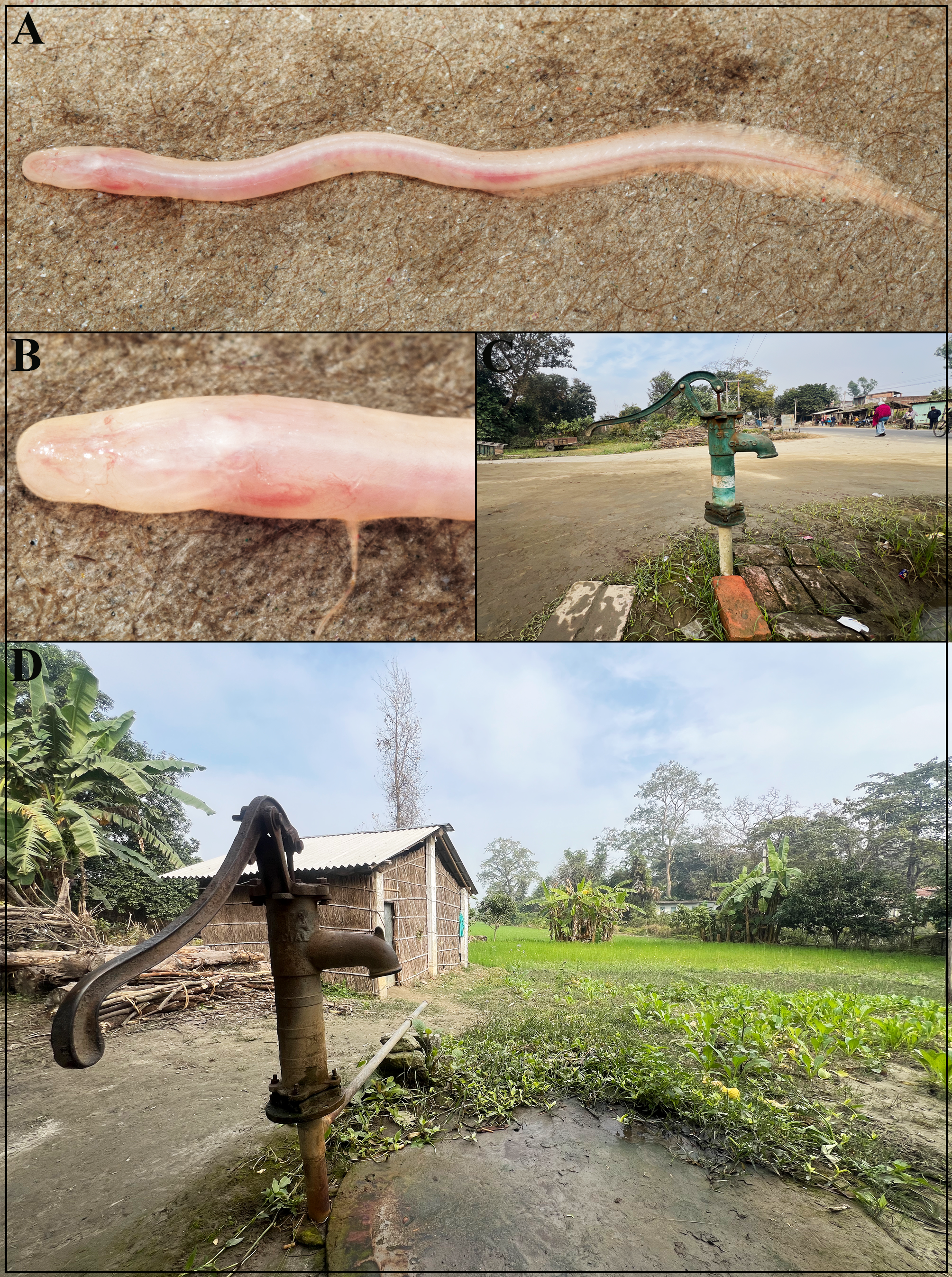
Researchers have discovered a new genus and species of underground earthworm eel living beneath the Indo-Gangetic Plain in Bihar, northern India. The small, colourless creature, named Gangaichthys indonepalicus, is the first subterranean fish to be recorded from the Gangetic Basin.

Close-up of Gangaichthys indonepalicus. Image credit: Ishan Agarwal.

The research, published in ZooKeys, was carried out by an international team of scientists from the Thackeray Wildlife Foundation in Mumbai, India; Shivaji University in Kolhapur; the Shanghai Synchrotron Radiation Facility at the Chinese Academy of Sciences; and the Zoological Survey of India in Gopalpur-on-Sea.

The investigation began after a short video clip posted on TikTok in 2024 showed an unusual tiny fish emerging from a water borewell near the border between India and Nepal.

“The unique morphology of the fish in the video, and the fact that there are no known stygobitic fish known from the region, motivated us to track down the species to ascertain its identity.”

The Research Team

Securing physical samples required an intensive fieldwork effort in Bihar, where the scientists manually pumped thousands of litres of water from local handpumps.

“Procuring samples of this unusual fish was challenging. Identifying potential handpumps (borewells) and wells, and obtaining permission from their owners to extract water for the purpose of searching for the fish proved difficult. This became more intensive when we finally began manually pumping water.”

Akshay Khandekar, Thackeray Wildlife Foundation
Live and habitat photos Gangaichthys indonepalicus
Live and habitat photos Gangaichthys indonepalicus: NRC AA 9519, holotype, 40.6 mm SL: Dorso lateral view of: A. Full body; B. Head; C. Bore-well from which holotype and one (damaged) paratype was collected; D. Bore-well from where another damaged specimen was collected. Image credit: Akshay Khandekar et al., 2026.

The first specimen emerged after pumping approximately 2000 litres of water but sustained damage during the process and died immediately. The second and only intact specimen (later designated as the holotype of this species) was found from the same borewell after pumping an additional 500 litres of water.

Gangaichthys indonepalicus in a syringe. Image credit: Ishan Agarwal.

The newly described fish measures roughly four centimetres in length and features physical adaptations suited to life in total darkness, including reduced eyes covered by skin, an unpigmented translucent body, and an apparent absence of ribs.

Advanced micro-CT scanning and genetic analysis confirmed that it represents a completely distinct genus within the earthworm eel family Chaudhuriidae.

“Gangaichthys means fish of the Ganga. The Ganga or Ganges is one of the most important rivers in India, both as a source of fresh water, food and livelihood for millions of people; besides having an important role in the Hindu religion.

This is the first stygobitic fish from the Indo-Gangetic plains and from the Gangetic basin.”

Ishan Agarwal, Thackeray Wildlife Foundation

As for the naming of the species itself, Tejas Thackeray commented:

“As the species occurs on the border between India and Nepal we picked indonepalicus as the specific epithet, which reflects the distribution of the species.”

Gangaichthys indonepalicus. Image credit: Ishan Agarwal.

Agarwal also reflected on the broader context of the find and the challenges of studying subterranean habitats:

“India is an incredibly diverse country, spanning huge gradients in climate and topography and multiple biogeographic regions. However, there is a huge gap in knowledge, both Linnaean and Wallacean shortfalls, with many more species yet to be discovered.

This exciting discovery is in some ways symptomatic of general biodiversity research in India, though sampling subterranean habitats is especially challenging.”

Original source:

Khandekar A, Thackeray T, He Y, Mohapatra A, Agarwal I (2026) Gangaichthys indonepalicus, a new genus and species of miniature stygobitic earthworm eel (Synbranchiformes, Chaudhuriidae) from alluvial aquifers in the Indo-Gangetic Plain, Bihar, northern India. ZooKeys 1289: 185-202. https://doi.org/10.3897/zookeys.1289.188089


For more articles on zoology, visit the ZooKeys website and follow the journal on BlueSky and Facebook.