The “sea capital” of Bulgaria, the city of Varna, hosted a very special occasion during the past week – an international conference marking the 20th anniversary of the LTER-BG network. Over the past two decades, its members have been dedicated to establishing roadmaps and infrastructures for generating, consolidating and sharing ecosystem research data across the Balkan country and beyond.
In celebration of this milestone, members of the wider eLTER community, encompassing the whole of Europe, contributed to a three-day agenda packed with progress updates, innovative showcases and meaningful discussions on the past and future of long-term ecosystem, critical zone and socio-ecological research.
The participants in the LTER Bulgaria international scientific conference 2026.
Pensoft Publishers has served as the communication and dissemination partner for the eLTER Research Infrastructure for the past six years. Pensoft has also always supported the activities of LTER Bulgaria.
For this 20th anniversary conference, all 55 abstracts for oral and poster presentations were organised and published in a special collection titled “Long-Term Ecosystem Research: Contributions, Challenges and Future Perspectives” on the ARPHA Conference Abstracts, and for less than a week it has already garnered over 6,000 views.
Conference abstracts published in ARPHA Conference Abstracts.
Impressed by the statements of engagement made by young scientists within the eLTER community, the Pensoft team supported the organisers’ idea to provide an Early Career Scientist Award, which granted its recipient a free publication in the One Ecosystem journal.
As the official communication partner of eLTER and its affiliated projects, Pensoft provided dissemination materials by eLTER RI at the dedicated booth where attendees also had the opportunity to familiarise themselves with the company’s wider publishing and research project portfolio.
At the booth, participants could get acquainted with Pensoft’s wider scientific journal portfolio. With One Ecosystem and Nature Conservation covering ecosystem science and conservation practices,NeoBiota focuses on biological invasions and Advances in Pollinator Research dedicated to all things pollinator science.Individual-based Ecologypublishes research on individual-level ecological processes while the Biodiversity Data Journal supports the publication of biodiversity data. Alongside these, Research Ideas and Outcomes offers a platform for sharing research across the whole project cycle, from proposals to final results.
ORPHO and Scientiana promo materials
Metabarcoding and Metagenomics brochure.
Frontiers of Biogeography brochure.
Advances in Pollinator Research promo materials.
Individual-based Ecology promo material.
One Ecosystem journal brochure.
NeoBiota promo materials.
Beyond these commitments, Pensoft was front and centre within the event’s agenda as well.
Alexandra Tzvetkova during the opening panel.
During the opening panel, Alexandra Tzvetkova, part of the Pensoft team working for eLTER RI, welcomed the participants, reminded them to start sharing the special collection of abstracts with their networks and highlighted the innovative propositions from Pensoft that were about to be presented in the next days and could be very useful for the eLTER community in the future – Scientiana and ORPHO.
Further, two Pensoft presentations were delivered as part of the thematic session “Emerging Technologies in Ecosystem Research, Data Management and Open Science in LTER”, and brought the audience closer to the publisher’s vision for the future:
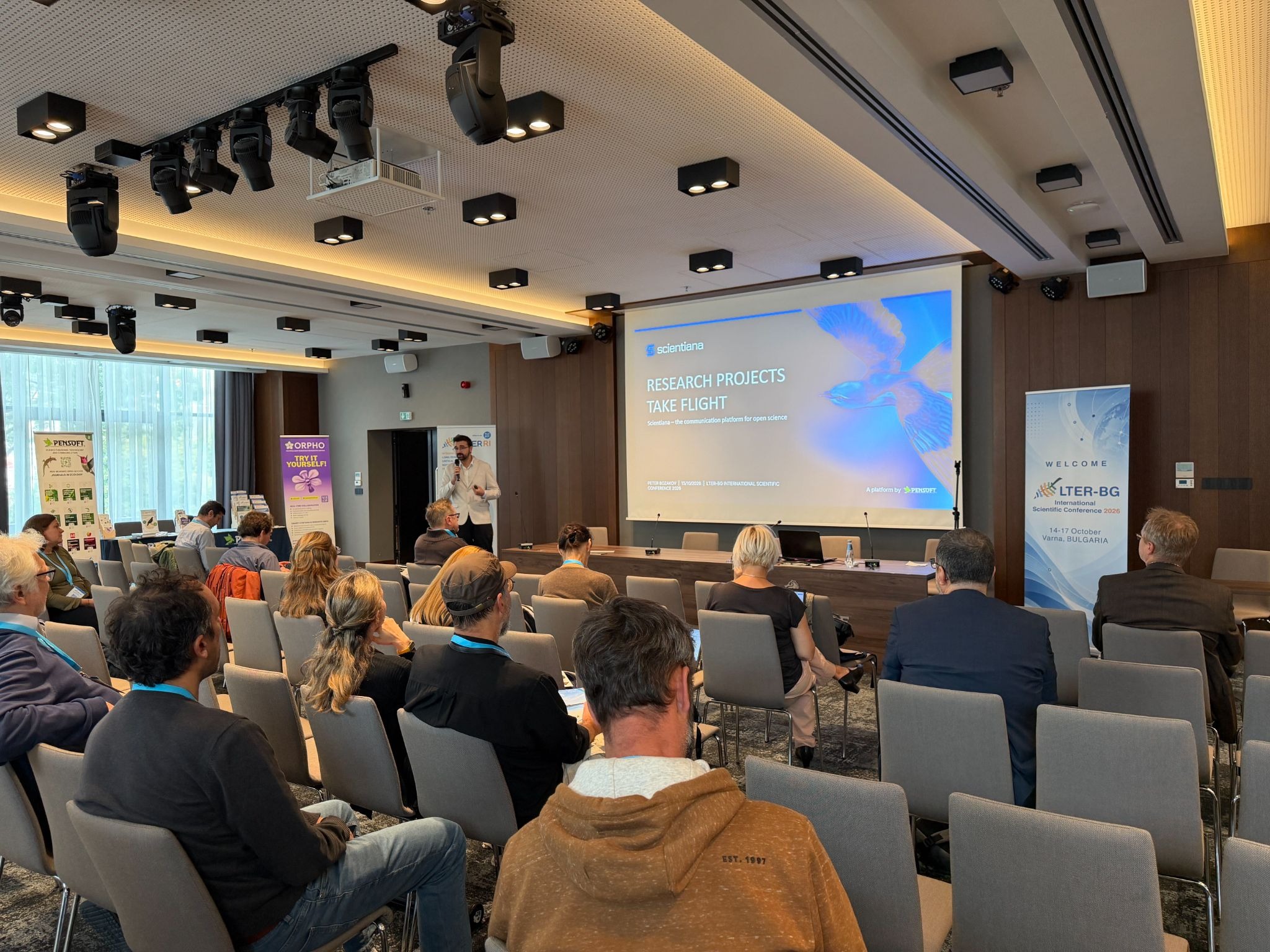
Senior Communications Officer Peter Bozakov delved into the forthcoming science communication platform for research projects Scientiana. Launching in early 2027, it is set to be a portal for consolidating knowledge, mapping out collaborations and innovating outreach in the context of past, present and future scientific initiatives at all scales.
Peter Bozakov introduces Pensoft’s newest platform – Scientiana.
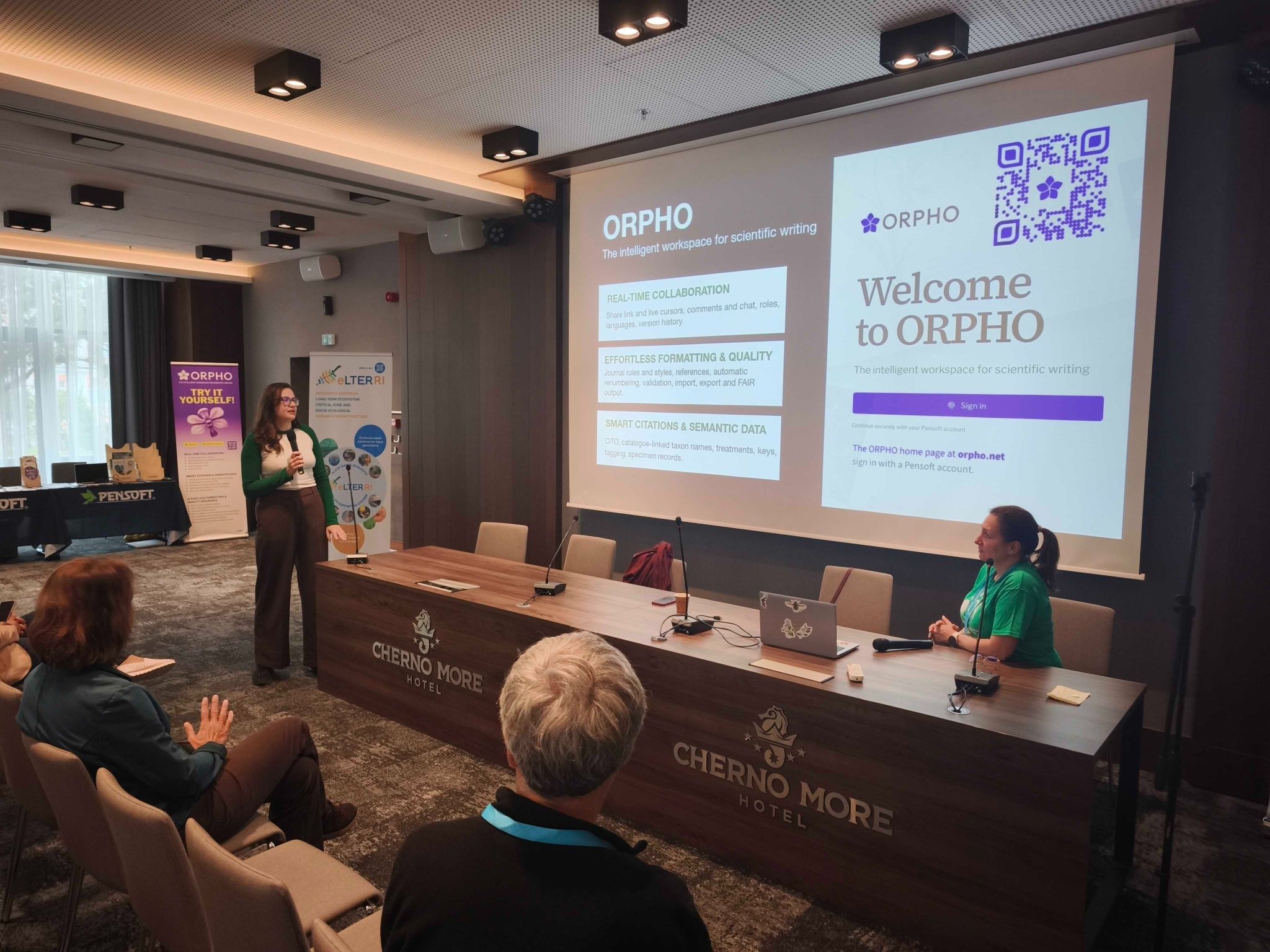
While, Events and Marketing Coordinator Victoria Stoyanova explored the new frontiers that an AI-FAIR outlook unveils in the domain of academic publishing. Specifically, she showcased the evolution of the ARPHA platform and the newly launched ORPHO, Pensoft’s next-gen collaborative writing tool, as examples of innovation placed directly in the hands of authors.
Together, ARPHA and ORPHO support the entire manuscript workflow from submission to publication, with structuring, taxon tagging, classification, and data publication taking place as part of the publication process itself.
A crash course in using ORHPO by Victoria Stoyanova
The presentations proved themselves a stepping stone to further discussions on potential collaborations with scientists, conversations that were bolstered by on-site demonstrations of the tools in question.
The conference in Varna was enjoyable, fruitful and full of hope and esteem for the better future of long-term ecosystem research. And our Pensoft team left with many ideas and an affirmed ambition to keep working to provide better solutions and services for the development of European science. What we will always remember are the words of our host – the national coordinator of LTER Bulgaria in the past 20 years, Svetla Doncheva-Bratanova:
I would like to thank the Pensoft team for the wonderful participation in the conference. You are amazing and I am certain we could do wonders together!
Many thanks to the Bulgarian LTER community and the wider eLTER community for bringing together so many passionate researchers and making these past few days special.
This Open Access Week, discover how Pensoft championed open access since ZooKeys through fair APCs, ARPHA tools and FAIR data.
For millennia, people have gathered data and knowledge – about where to hunt, eat, trade, and live – and shared it through experiences, stories and songs. Today, we continue to do so by creating and sharing knowledge in order to “advance human understanding and the common good.”
This year’s International Open Access Week theme, “The Cost of Knowledge,” reminds us that sharing knowledge has a price: subscription fees and article processing charges, the time and expertise of authors, reviewers and editors, and the investment and know-how behind user-friendly digital infrastructures.
At Pensoft, open access has never been an add-on. Founded in 1992 by scientists for scientists, we launched our first journal, ZooKeys, as fully open access in 2008, and it has been open from its very first issue. After all, it has always been our thinking that research can only serve the common good when everyone can read it, use it and build on it. This is why from the very start, we wanted ZooKeys to speed up research and free the exchange of information in taxonomy.
In 2025, together with long-term collaborators from the open-science community, we founded the quite revolutionary and unique journal Research Ideas and Outcomes (RIO) with the aim to catalyse the culture change in research communication by publishing ideas, project proposals, data/software management plans and various other outcomes that would typically be lost for the scientific community. The recognition for RIO’s approach to scholarly communication came only half a year later when SPARC went on to name an Open Science Innovator.
ARPHA Publishing Platform – homepage.
Throughout our existence as a publisher all of our journals have been 100% open access. Hosted on our own ARPHA Publishing Platform and operating under CC BY license, all scholarly titles in our portfolio make sure that every article can be read, shared and reused freely while authors retain the copyright to their work.
Our proprietary ARPHA Publishing Platform offers a full-featured, end-to-end open access publishing and hosting solution, with a suite of connected services built around it.
The ARPHA suite
Apart from about 100 open-access scholarly journals, ARPHA powers the ARPHA Preprints platform, which seamlessly integrates with journals to let authors make their manuscripts publicly available upon submission; the platform also provides high-quality and technologically advanced open-access publication for conference outputs through ARPHA Proceedings and ARPHA Conference Abstracts. Through Advanced Books, authors and researchers can bring whole open access books to readers in semantically enhanced HTML and PDF formats.
ORPHO – the next-gen tool for scientific writing
Most recently, we launched ORPHO, our next-generation collaborative workspace for scientific writing. Within ORPHO, researchers and authors can enrich their manuscripts semantically, so that their research, as well as underlying data remains FAIR (Findable, Accessible, Interoperable, and Reusable) and AI-ready.
Together, these tools streamline the publication of text and semantically rich data, making openness a natural part of the research workflow rather than an extra step.
Also, along with Plazi, we run the Biodiversity Literature Repository on Zenodo, which gives articles, figures and taxonomic treatments their own DOIs and releases them under CC0, so the data inside publications can be found, cited and reused by platforms such as GBIF.
This is what a publisher built by scientists can offer: a model that treats knowledge as something to be shared, prices that stay open and transparent, and infrastructure that makes research easier to find, reuse and trust.
Throughout our existence as a scholarly publisher and technology provider, Pensoft has always considered it our responsibility to ensure that valuable research outputs are shared efficiently with the world. This gives everyone, everywhere, the opportunity to make sense of and use this knowledge, while giving full credit to the scientists behind it. This is how, in our vision, scientific work and knowledge can achieve optimal impact on society and future research.
comments Iva Boyadzhieva, Head of Journal development and PR at Pensoft.
Reclaiming knowledge as a common good
Open Access Week 2026 at Pensoft
As this year’s Open Access Week puts it:
“Momentum is growing for approaches to treat knowledge as a common good and not a commodity to be mined.” – Open Access Week 2026
We believe that momentum is real, and we have seen it grow ever since the first issue of ZooKeys. At Pensoft we are proud to say that we have championed open access in publishing, building the tools, workflows and partnerships that make it work in practice, and we will keep doing so alongside the institutions, funders, editors and researchers who share this commitment.
Between 26-31 July, Pensoft Publishers joined more than 2,600 ecologists, researchers, and conservation professionals in Salt Lake City for the 111th Annual Meeting of the Ecological Society of America (ESA2026).
Pensoft Publishers joined more than 2,600 ecologists, researchers, and conservation professionals in Salt Lake City for the 111th Annual Meeting of the Ecological Society of America (ESA2026) between 26-31 July.
This year’s conference theme, “Ecology in an Era of Uncertainty,” could not have felt more timely. Uncertainty is nothing new to ecological research – it’s built into measurements, mechanisms, and predictions.
But new sources of uncertainty are now reshaping the field: the rise of artificial intelligence, post-pandemic shifts in career development, and growing instability in research funding. Throughout the week, the ESA community came together not only to share cutting-edge ecological research, but also to think collectively about how to navigate these emerging challenges – trading multidisciplinary, creative solutions to keep the field resilient in the face of what’s next.
The Opening Session
The Grand Ballroom was packed for the opening session, where Conference Chairs Daniel Stover and Andrea Swei welcomed attendees. Despite a challenging year for funding and travel, the 111th annual meeting of ESA 2026 hosted 2,600 registered attendees 330 sessions and 884 posters,
The opening address was delivered by Diane Pitaki, Chief Scientist and Vice President for Science at the National Wildlife Federation, who spoke about ecology standing at a crossroads amid the biodiversity crisis and shifting political headwinds, urging the community to actively “defend conservation science.”
Among the meeting’s standout moments was the plenary from Tanya Berger-Wolf, Professor of Computer Science and Ecology at Ohio State University and a leading figure in AI for ecology and biodiversity.
Notably, Berger-Wolf will be a keynote speaker at TDWG 2026 in Oslo (20-25 September) – where Pensoft Publisherswill once again be exhibiting, so stay tuned for future updates.
Situated right at the entrance of the exhibition hall, Pensoft’s booth revelled in attention from attendees throughout the week.
Pensoft’s team at ESA 2026 in Salt Palace Convention Center.
Pensoft’s busy stand at the 111th Annual Meeting of the Ecological Society of America.
Pensoft’s busy stand at the 111th Annual Meeting of the Ecological Society of America.
The beautiful Denitsa Peneva’s illustrations at ESA 2026.
A particular highlight was our trio of diamond open-access journals – free to publish in and free to read – that drew considerable interest from attendees:
Individual-Based Ecology promotes a distinctive individual-based perspective on ecology, aiming to bridge individual behaviour and broader ecological patterns.
Advances in Pollinator Research is designed as an innovative platform for the full spectrum of pollinator science, from pollination ecology and pollinator-plant interactions to molecular ecology, conservation, and more.
Agricultural and Environmental Modelling (AEM), meanwhile, offers an innovative approach to publishing, dedicated to advancing both the science and practice of modelling across agriculture, food systems, natural resources, and environmental sciences.
Brochure of the diamond open-access Individual Based Ecology Journal.
Close up photo of the Advances in Pollinator Research brochure at ESA 2026.
Nicole Nogoy, managing editor of Agricultural and Environmental Modelling at ESA 2026.
Attendees curious about AEM had the chance to speak directly with its Managing Editor, Nicole Nogoy, who was on site throughout the conference to discuss publishing opportunities and promote the journal’s search for Subject Editors.
We also introduced attendees to our newest addition, the diamond open-accessJournal of Regeneration. For those interested in sharing early-stage research or project outcomes, Research Ideas and Outcomes (RIO) offered another avenue worth exploring, publishing everything from project proposals and data to policy briefs and null results.
Those looking for a new publisher or white-label solutions had the opportunity to exploreARPHA, Pensoft’s own publishing platform, which supports the full journey from manuscript writing and peer review to publication, dissemination, and archiving – all in one seamless workflow.
Combined brochure of EU-Funded project in which Pensoft participates.
Beyond the journals and publishing solutions, the team took the opportunity to spotlight some of Pensoft’s ongoing EU-funded projects, including our pollination initiatives and our continued work with eLTER.
This time around, our team created “Pensoft Species Quiz,” challenging booth visitors to identify the correct Latin name for a series of species beautifully illustrated by Denitsa Peneva. Being more than just a fun activity, it became a natural conversation starter – leading into deeper discussions about Pensoft’s journals, services, and potential collaborations with attendees.
Some of the winners from our quiz at ESA 2026.
Some of the winners from our quiz at ESA 2026.
Happy winners from our interactive quiz game at ESA 2026.
Attendees interacting with our fun quiz.
The Agricultural and Environmental Modelling Poster Award
AEM’s Managing Editor – Nicole Nogoy ran a poster competition at the meeting, and it turned out to be one of the highlights of our week. Three researchers stood out:
Julian Resasco (University of Colorado, Boulder) took home the prize for overall best presentation with a hand-drawn comic-book poster on climate change effects on Basque country thistles;
Gwendolyn Lloyd (Indiana University) impressed us with her research on arthropods and mites in agricultural soils;
Emily Redding (Fort Hays State University, KS) joined in with a poster on fire suppression’s effects on Juniper-dependent bird species, having been inspired to bring modelling into her own research.
We also took part in a raffle organised by ESA, to which each exhibitor contributed a prize.
Kanchana Balasubramanian one of the winners of Pensoft Publishers’ raffle prizes at ESA2026.
Elizabeth Afkhami Searcy received our book “Mapping Ecosystem Services” as part of the Ecological Society of America’s conference raffle.
ESA2026 was a strong reminder of just how much energy – and uncertainty – is currently shaping the ecology community. Between thought-provoking plenaries on AI and conservation science, engaging conversations sparked by our species quiz, and the enthusiasm we saw around the AEM poster competition, it was a week full of meaningful connections for Pensoft.
We’re already looking forward to the next time, and we hope you’re looking forward to it, too!
Content from 20 Pensoft journals will now be automatically added to ResearchGate to reach the research network’s 25 million users. Each journal will also receive a dedicated profile.
ResearchGate, the professional network for researchers, and Pensoft today announced a new partnership that will see a set of Pensoft’s open access journals increase their reach and visibility through ResearchGate – increasing access and engagement with its 25 million researcher members.
As part of this new partnership, 20 journals published by Pensoft – including the publisher’s flagship titles ZooKeys, PhytoKeys, MycoKeys, Biodiversity Data Journal and Research Ideas and Outcomes (RIO Journal) amongst others – will now have their content automatically added to ResearchGate upon publication to benefit from enhanced visibility and discoverability through ResearchGate’s innovative Journal Home offering. These journals will all have dedicated profiles and be prominently represented on all associated article pages on ResearchGate, as well as all other relevant touch points throughout the network.
Journal Home provides a unique opportunity for Pensoft to connect its authors with their readers. The new journal profiles on ResearchGate will provide a central location for each journal, enabling researchers to learn more, discover new article content, and understand how, through their network, they are connected to the journal’s community of authors and editors. Authors of these journals additionally benefit from having their articles automatically added to their ResearchGate profile page, giving them access to metrics, including who is reading and citing their research. These rich insights will also enable Pensoft to build a deeper understanding of the communities engaging with its journals.
“Pensoft is delighted to be working with ResearchGate to provide an even greater service to our authors and readers. ResearchGate offers an innovative way for us to grow the reach and visibility of our content, while also giving us a way to better understand and engage our author and reader audiences.”
said Prof Lyubomir Penev, CEO and founder of Pensoft.
“We couldn’t be happier to see Pensoft embark on this new partnership with ResearchGate. Journal Home will not only enable Pensoft authors to build visibility for their work, but provide them and Pensoft with greater insights about the communities engaging with that research. I look forward to seeing this new collaboration develop”
said Sören Hofmayer, co-founder and Chief Strategy Officer at ResearchGate.
About ResearchGate:
ResearchGate is the professional network for researchers. Over 25 million researchers use researchgate.net to share and discover research, build their networks, and advance their careers. Based in Berlin, ResearchGate was founded in 2008. Its mission is to connect the world of science and make research open to all.
Now, readers can explore not just how many times an article has been cited, but also why
In the ever-evolving landscape of academic publishing, comprehensive and informative citation metrics can make all the difference. Pensoft, the scholarly publisher and technology provider, and the innovative scite.ai platform, have partnered to provide a novel service that is looking to change the way readers perceive and utilise citation data.
scite.ai has been making waves in the scholarly world with its pioneering approach to citation metrics. At the heart of their offering are two distinctive badges, elegantly displayed on the article’s page to let readers gain deeper insights into how a publication is cited by other indexed works.
Each citation is categorized as Supporting, Contrasting, or Mentioning, based on the context of surrounding sentences within the citing publication. This way, anyone can explore not just how many times a document has been cited but also why.
The feature is already accessible under the Metrics tab of any research paper published by a Pensoft journal. The first scite.ai badge displays the number of citations, breaking them down into Supporting, Contrasting, or Mentioning; the second one offers insights on the sections of an article where the citations were featured.
At Pensoft, we are confident that this new functionality enhances the discoverability and contextual richness of articles published in our journals. The integration also empowers Pensoft’s users to gain deeper insights into their research. Whether you’re a scientist seeking to validate your research or a reader in search of authoritative sources, this new feature promises to enrich your academic journey.
***
Stay up to date with the latest integrations and features available at journals published by Pensoft by following ARPHA Platform on Twitter and Linkedin.
As behaviours and needs of readers change, we strive to keep up with the times. Let’s run through what & why has changed to the PDF format.
Readers at some of the journals published by Pensoft, who have downloaded/printed a publication or ordered a physical copy of a journal issue over the last few weeks, might be in for a surprise concerning the layout of the PDF format of the articles.
Research papers published in ZooKeys demonstrating the former (left) and the current (right) article layout seen in the PDF format.
Even though it’s been years since online publishing has become the norm in how we are consuming information – including scientific publications – we understand that academia is still very much fond of traditional, often paper-based, article layout format: the one you use when accessing a PDF file or a print copy, rather than directly scrolling down through the HTML version of the article.
Even if today large orders of printed volumes from overseas are the exception, rather than the rule, we know we have readers of ours who regularly print manuscripts at home or savе them on their devices. Trends like this have already led to many journals first abandoning the physical- for digital-first, then transitioning to digital-only publication format.
Meanwhile, it is true that needs and demands have fundamentally changed in recent times.
As we speak, readers are accessing PDF files from much higher-quality desktops, in order to skim through as much content as possible.
In the meantime, authors are relying on greater-quality cameras to document their discoveries, while using advanced computational tools capable of generating and analysing extra layers of precise data. While producing more exhaustive research, however, it is also of key importance that their manuscripts are processed and published as rapidly as possible.
So, let’s run through the updates and give you our reasoning for their added value to readers and authors.
Revised opening page
One of the major changes is the one to the format of the first page. By leaving some blank space on the left, we found a dedicated place for important article metadata, i.e. academic editor, date of manuscript submission / acceptance / publication, citation details and licence. As a result, we “cleaned up” the upper part of the page, so that it can better highlight the authors and their affiliations.
Bottom line: The new layout provides a better structure to the opening page to let readers find key article metadata at a glance.
Expand as much – or as little – as comfortable
As you might know, journals published by Pensoft have been coming in different formats and sizes. Now, we have introduced the standard A4 page size, where the text is laid in a single column that has been slightly indented to the right, as seen above. Whenever a figure or a table is used in a manuscript, however, it is expanded onto the whole width of the page.
Before giving our reasons why, let’s see what were the specific problems that we address.
Case study 1
Some of our signature journals, including ZooKeys, PhytoKeys and MycoKeys, have become quite recognisable with their smaller-than-average B5 format, widely appreciated by people who would often be seen carrying around a copy during a conference or an international flight.
However, in recent times, authors began to embrace good practices in research like open sharing of data and code, which resulted in larger and more complex tables. Similarly, their pocket-sized cameras would capture much higher-resolution photos capable of revealing otherwise minute morphological characters. Smaller page size would also mean that often there would be pages between an in-text reference of a figure or a table and the visual itself.
So, here we faced an obvious question: shall we deprive their readers from all those detailed insights into the published studies?
Yet, the A4 format brought up another issue: the lines were too long for the eye comfort of their readers.
What they did was organise their pages into two-column format. While this sounds like a good and quite obvious decision, the format – best known from print newspapers – is pretty inconvenient when accessed digitally. Since the readers would like to zoom in on the PDF page or simply access the article on mobile, they will need to scroll up and down several times per page.
In addition, the production of a two-column text is technologically more challenging, which results in extra production time.
Bottom line: The new layout allows journals to not sacrifice image quality for text readability and vice versa. As a bonus, authors enjoy faster publication for their papers.
Simplified font
If you have a closer look at the PDF file, you would notice that print-ready papers have also switched to a more simplistic – yet easier to the eye – font. Again, the update corresponds to today’s digital-native user behaviour, where readers often access PDF files from devices of various resolutions and skim through the text, as opposed to studying its content in detail.
In fact, the change is hardly new, since the same font has long been utilised for the webpages (HTML format) of the publications across all journals.
Bottom line: The slightly rounder and simplified font prompts readability, thereby allowing for faster and increased consumption of content.
What’s the catch? How about characters and APCs?
While we have been receiving a lot of positive feedback from editors, authors and readers, there has been a concern that the updates would increase the publication charges, wherever these are estimated based on page numbers.
Having calculated the lines and characters in the new layout format, we would like to assure you that there is no increase in the numbers of characters or words between the former and current layout formats. In fact, due to the additional number of lines fitting in an A4 page as opposed to B5, authors might be even up for a deal.
________
* At the time of the writing, the new paper layout has not been rolled out at all journals published by Pensoft. However, most of the editorial boards have already confirmed they would like to incorporate the update.
________
For news from & about Pensoft and our journal portfolio, follow us on Twitter, Facebook and Linkedin.
“Not only does it mean that content is persistent in merit and quality, but that innovative research outputs are already appreciated within academia,” says Editor-in-Chief Prof Dr Benjamin Burkhard
Seven years after its official launch in May 2016, the One Ecosystem journal has successfully completed the rigorous quality and integrity assessment at Web of Science.
The news means that One Ecosystem might see its very first Journal Impact Factor (JIF) as early as 2024, following the latest revision of the metric’s policies Clarivate announced last July. According to the update, all journals from the Web of Science Core Collection are now featured in the Journal Citation Reports, and thereby eligible for a JIF.
“Giving all quality journals a Journal Impact Factor will provide full transparency to articles and citations that have contributed to impact, and therefore will help them demonstrate their value to the research community. This decision is aligned to our position that publications in all quality journals, not just highly cited journals, should be eligible for inclusion in research assessment exercises,” said back then Dr Nandita Quaderi, Editor-in-Chief and Editorial Vice President at Web of Science.
“We are happy to learn that Web of Science has recognised the value and integrity of One Ecosystem in the scholarly landscape. Not only does it mean that the scientific content One Ecosystem has been publishing over the years is persistent in merit and quality, but that innovative research outputs are already widely accepted and appreciated within academia.
After all, one of the reasons why we launched One Ecosystem and why it has grown to be particularly distinguished in the field of ecology and sustainability is that it provides a scholarly publication venue for traditional research papers, as well as ‘unconventional’ scientific contributions,”
“These ‘unconventional’ research outputs – like software descriptions, ecosystem inventories, ecosystem service mappings and monitoring schema – do not normally see the light of day, let alone the formal publication and efficient visibility. We believe that these outputs can be very useful to researchers, as well as practitioners and public bodies in charge of, for example, setting up indicator frameworks for environmental reporting,”
“In fact, last year, we also launched a new article type: the Ecosystem Accounting table, which follows the standards set by the the System of Environmental-Economic Accounting Ecosystem Accounting (SEEA EA). This publication type provides scientists and statisticians with a platform to publish newly compiled accounting tables,”
Previously, One Ecosystem has been accepted for indexing at over 60 major academic databases, including Scopus, DOAJ, Cabell’s Directory, CABI and ERIH PLUS. In June 2022, the journal received a Scopus CiteScore reading 7.0, which placed it in Q1 in five categories: Earth and Planetary Sciences; Ecology; Nature and Landscape Conservation; Agricultural and Biological Sciences (miscellaneous); Ecology, Evolution, Behavior and Systematics.
To bridge the gap between authors and their readers or fellow researchers – whether humans or computers – Knowledge Pixels and Pensoft launched workflows to link scientific publications to nanopublications.
A new pilot project by Pensoft and Knowledge Pixels breaks scientific knowledge into FAIR and interlinked snippets of precise information
As you might have already heard, Knowledge Pixels: an innovative startup tech company aiming to revolutionise scientific publishing and knowledge sharing by means of nanopublications – recently launched a pilot project with the similarly pioneering open-science journal Research Ideas and Outcomes (RIO), in a first of several upcoming collaborations between the software developer and the open-access scholarly publisher Pensoft.
“The way how science is performed has dramatically changed with digitalisation, the Internet, and the vast increase in data, but the results are still shared in basically the same form and language as 300 years ago: in narrative text, like a story. These narratives are not precise and not directly interpretable by machines, thereby not FAIR. Even the latest impressive AI tools like ChatGPT can only guess (and sometimes ‘hallucinate’) what the authors meant exactly and how the results compare,”
said Philipp von Essen and Tobias Kuhn, the two founders of Knowledge Pixels in a press announcement.
So, in order to bridge the gap between authors and their readers and fellow researchers – whether humans or computers – the partners launched several workflows to bi-directionally link scientific publications from RIO Journal to nanopublications. We will explain and demonstrate these workflows in a bit.
Now, first, let’s see what nanopublications are and how they contribute to scientific knowledge, researchers and scholarship as a whole.
Basically, a nanopublication – unlike a research article – is just a tiny snippet of a scientific finding (e.g. medication X treats disease Y), which exists as a complete and straightforward piece of information stored on a decentralised server network in a specially structured format, so that it is readable for humans, but also “understandable” and actionable for computers and their algorithms.
A nanopublication may also be an assertion related to an existing research article meant to support, comment, update or complement the reported findings.
In fact, nanopublications as a concept have been with us for quite a while now. Ever since the rise of the Semantic Web, to be exact. At the end of the day, it all boils down to providing easily accessible information that is only a click away from additional useful and relevant content. The thing is, technological advancement has only recently begun to catch up with the concept of nanopublications. Today, we are one step closer to another revolution in scientific publishing, thanks to the emergence and increasing adoption of what we call knowledge graphs.
“As pioneers in the semantic open access scientific publishing field for over a decade now, at Pensoft we are deeply engaged with making research work actually available at anyone’s fingertips. What once started as breaking down paywalls to research articles and adding the right hyperlinks in the right places, is time to be built upon,”
said Prof. Lyubomir Penev, founder and CEO at Pensoft: the open-access scholarly publisher behind the very first semantically enhanced research article in the biodiversity domain, published back in 2010 in the ZooKeys journal.
Why nanopublications?
Apart from enabling computer algorithms with wholesome access to published research findings, nanopublications allow for the knowledge snippets that they are intended to communicate to be fully understandable and actionable. With nanopublications, each byte of knowledge is interconnected and traceable back to its author(s) and scientific evidence.
Nanopublications present a complete and straightforward piece of information stored on a decentralised server network in a specially structured format, so that it is readable for humans, but also “understandable” and actionable for computers and their algorithms. Illustration by Knowledge Pixels.
By granting computers the capability of exchanging information between users and platforms, these data become Interoperable (as in the Iin FAIR), so that they can be delivered to the right user, at the right time, in the right place.
Another issue nanopublications are designed to address is research scrutiny. Today, scientific publications are produced at an unprecedented rate that is unlikely to cease in the years to come, as scholarship embraces the dissemination of early research outputs, including preprints, accepted manuscripts and non-conventional papers.
By linking assertions to a publication by means of nanopublications allows the original authors and their fellow researchers to keep knowledge up to date as new findings emerge either in support or contradiction to previous information.
A network of interlinked nanopublications could also provide a valuable forum for scientists to test, compare, complement and build on each other’s results and approaches to a common scientific problem, while retaining the record of their cooperation each step along the way.
A scientific issue that would definitely benefit from an additional layer of provenance and, specifically, a workflow allowing for new updates to be linked to previous publications is the biodiversity domain, where species treatments, taxon names, biotic interactions and phylogenies are continuously being updated, reworked and even discarded for good. This is why an upcoming collaboration between Pensoft and Knowledge Pixels will also involve the Biodiversity Data Journal (stay tuned!)
What can you do in RIO?
Now, let’s have a look at the *nano*opportunities already available at RIO Journal.
The integration between RIO and Nanodash: the environment developed by Knowledge Pixels where users edit and publish their nanopublications is available at any article published in the journal.
Add reaction to article
This function allows any reader to evaluate and record an opinion about any article using a simple template. The opinion is posted as a nanopublication displayed on the article page, bearing the timestamp and the name of the creator.
All one needs to do is go to a paper, locate the Nanopubs tab in the menu on the left and click on the Add reaction command to navigate to the Nanodash workspace accessible to anyone registered on ORCiD.
To access the Nanodash workspace, where you can fill in a ready-to-use, partially filled in nanopublication template, simply go to the Nanopubs tab in the menu of any article published in RIO Journal and click Add reaction to this article (see example).
Within the simple Nanodash workspace, the user can provide the text of the nanopublication; define its relation to the linked paper using the Citation Typing Ontology (CiTO); update its provenance and add information (e.g. licence, extra creators) by inserting extra elements.
To do this, the Knowledge Pixels team has created a ready-to-use nanopublication template, where the necessary details for the RIO paper and the author that secure the linkage have already been pre-filled.
Post an inline comment as a nanopublication
Another opportunity for readers and authors to add further meaningful information or feedback to an already published paper is by attaching an inline comment and then exporting it to Nanodash, so that it becomes a nanopublication. To do this, users will simply need to select some text with a left click, type in the comment, and click OK. Now, their input will be available in the Comment tab designed to host simple comments addressing the authors of the publication.
While RIO has long been supporting features allowing for readers to publicly share comments and even CrossRef-registered post-publication peer reviews along the articles, the nanopublications integration adds to the versatile open science-driven arsenal of feedback tools. More precisely, the novel workflow is especially useful for comments that provide a particularly valuable contribution to a research topic.
To make a comment into a nanopublication the user needs to locate the comment in the tab, and click on the Post as Nanopub command to access the Nanodash environment.
Add a nanopublication while writing your manuscript
A functionality available from ARPHA Writing Tool – the online collaborative authoring environment that underpins the manuscript submission process at several journals published by Pensoft, including RIO Journal – allows for researchers to create a list of nanopublications within their manuscripts.
By doing so, not only do authors get to highlight their key statements in a tabular view within a separate pre-designated Nanopublications section, but they also make it easier for reviewers and scientific editors to focus on and evaluate the very foundations of the paper.
By incorporating a machine algorithm-friendly structure for the main findings of their research paper, authors ensure that AI assistants, for example, will be more likely to correctly ‘read’, ‘interpret’ and deliver the knowledge reported in the publication for the next users and their prompts. Furthermore, fellow researchers who might want to cite the paper will also have an easier time citing the specific statement from within the cited source, so that their own readers – be it human, or AI – will make the right links and conclusions.
Within a pre-designated article template at RIO – regardless of the paper type selected – authors have the option to either paste a link to an already available nanopublication or manage their nanopublication via the Nanodash environment by following a link. Customised for the purposes of RIO, the Nanodash workspace will provide them with all the information needed to guide them through the creation and publication of their nanopublications.
Why Research Ideas and Outcomes, a.k.a. RIO Journal?
Why did Knowledge Pixels and Pensoft opt to run their joint pilot at no other journal within the Pensoft portfolio of open-access scientific journals but the Research Ideas and Outcomes (RIO)?
Well, one may argue that there simply was no better choice than an academic outlet that was initially designed to serve as “the open-science journal”: something it has been honourably recognised for by SPARC in 2016, only one year since its launch.
Innovative since day #1, back in 2015, RIO surfaced as an academic outlet to publish a whole lot of article types, reporting on scientific work from across the research process, starting from research ideas, grant proposals and workshop reports.
After all, back in 2015, when it was only a handful of funders who required Data and Software Management Plans to be made openly and publicly, RIO was already providing a platform to publish those as easily citable research outputs, complete with DOI and registration on Crossref. In the spirit of transparency, RIO has always operated an open and public by default peer review policy.
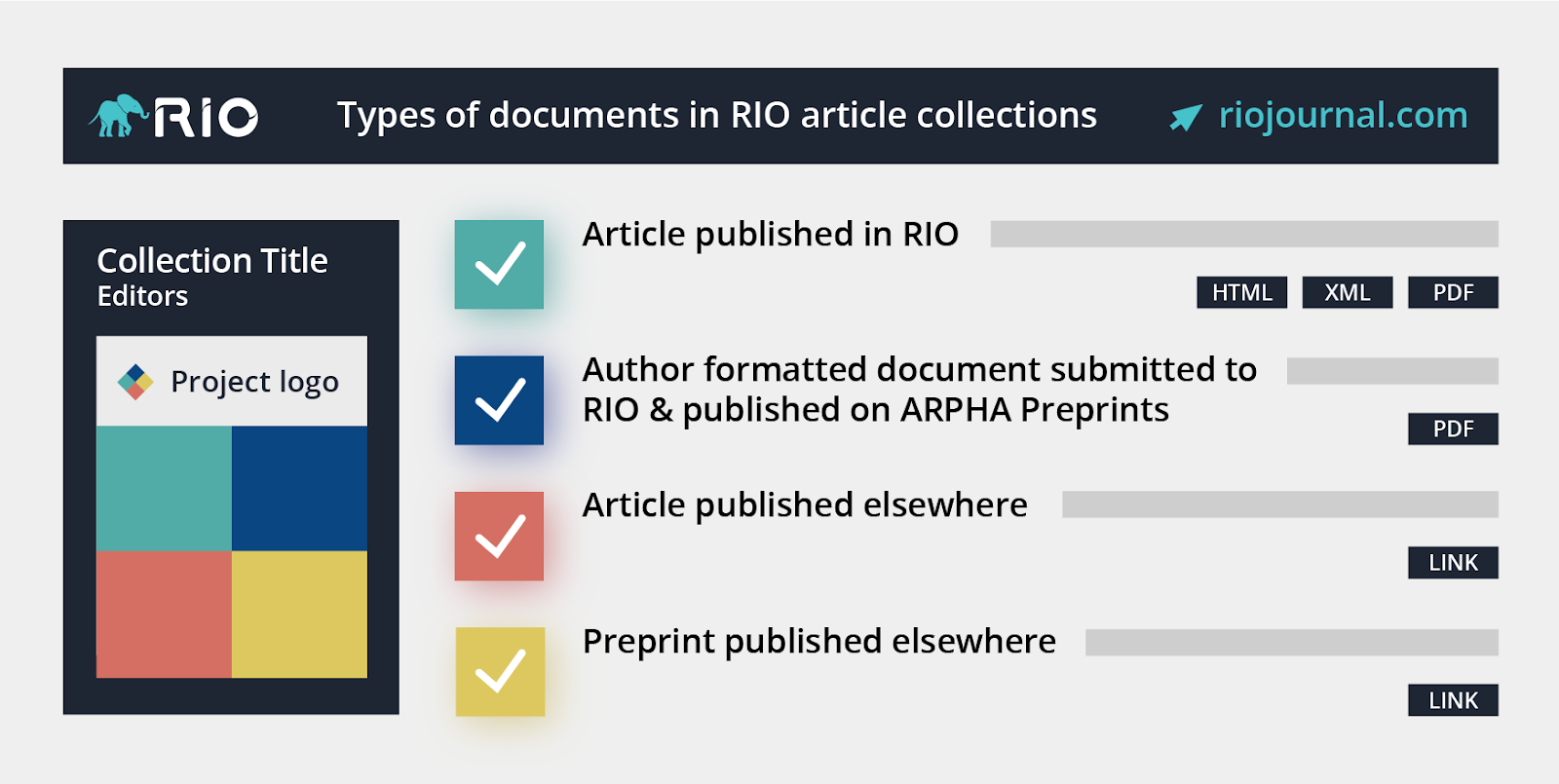
More recently, RIO introduced a novel collections workflow which allows, for example, project coordinators, to provide a one-stop access point for publications and all kinds of valuable outputs resulting from their projects regardless of their publication source.
Bottom line is, RIO has always stood for innovation, transparency, openness and FAIRness in scholarly publishing and communication, so it was indeed the best fit for the nanopublication pilot with Knowledge Pixels.
***
We encourage you to try the nanopublications workflow yourself by going to https://riojournal.com/articles, and posting your own assertion to an article of your choice!
Don’t forget to also sign up for the RIO Journal’s newsletter via the Email alert form on the journal’s website and follow it on Twitter, Facebook, Linkedin and Mastodon.
Given scientific conferences present academics with the fantastic opportunity to meet up and discuss their latest work, as well as share their vision for the future of their field, it’s no wonder that, historically, the majority of ground-breaking science can easily be traced back to a particular event.
This said, don’t you think that we need to do everything within our powers toensure the visibility, dissemination and long-term accessibility of research presented and linked to these wonderful drivers of scientific progress that conferences are? Similarly to the care conference organisers take to make sure the event runs smoothly and the attendants are happy with the programme and enjoy themselves, the organisational committee should also be thinking how to preserve all those promising pieces of research well after the event is over.
Here at Pensoft, an open-access scholarly publisher, founded by scientists, we’ve been contemplating for a while now how to encourage and support the community to efficiently open up the valuable outputs to researchers and readers well beyond the publication of abstracts in an abstract book of the conference.
As a result, we came up with several simple, yet efficient publishing solutions for scientific conferences to collect and contextualise various research outputseither presented at or resulting from the event.
Bear in mind that with any solution, all publications enjoy the benefits seen in conventional research papers, such as:
Crossref registration and individual DOI to ensure preservation;
Publication in PDF, semantically enhanced HTML and data-minable XML formats to improve readability, accessibility and findability;
Indexing and archiving at multiple, industry leading databases to increase visibility;
PR and social media promotion to boost outreach to various audiences.
Collections of conference abstracts, posters and presentations
Conference (video) abstracts, posters and presentations are easily the first to fall victims of the ephemerality of an event, yet these are too often the stepping stones to major scientific discoveries. This is why a few years back we launched ARPHA Conference Abstracts (ACA), where conference organisers can open their own collection and provide the participants with submission, review and publication of their abstracts ahead of the conference.
Furthermore, these abstracts can be handled editorially in sub-collections, e.g. the convenors of symposia or working groups within a conference will take care of the abstracts submitted to them, thus spreading the editorial workload across larger teams of editors and organisers.
Not only will conference organisers spare themselves the worries about providing a special platform for abstracts submissions, but this will also facilitate presenting authors, who will be able to easily point to their contribution before, during or after their presentations. On the contrary, the abstracts are assigned with DOIs, published in human-readable PDF and HTML and machine-actionable JATS XML, permanently preserved on ARPHA and Zenodo, and easy to find, access and cite, just like a conventional research paper, providing authors with full credit for their work early on.
Further, with ACA, the conference abstracts can be enhanced into what we call “extended abstracts”, meaning they can also include data, images, videos and multimedia. After the conferences, we can add video recordings of the presentations or graphic files of posters, so that these are visualised on the page of each abstract.
About the time we launched ACA, we also created ARPHA Proceedings, in order to also find a place for full-text conference papers. Similarly, the platform supports dedicated collections, where conference attendants are invited to submit and publish dynamically articles under the imprint of the event.
Conference papers in ARPHA Proceedings can also include data, figures and citations, and can also be updated with video recordings, posters and presentations following the conference.
Article topical collections and special issues resulting from conferences
Naturally, papers resulting from a particular conference are contextually linked, so a one-stop place to discover topical studies sharing one and the same topic would be greatly appreciated by readers and future researchers. In turn, this would lead to better viewership and citability of the papers in the collection.
With our user-friendly, dedicated workflow for special issues and permanent topical article collections, we’ve made it easy for guest editors across our journals to pitch and manage article collections, in order to bring together valuable and related studies. Using such a collection under the theme of your conference in a suitable journal, you can invite your conference’s participants or, better yet, all scientists working within the field, to submit their work in a nice package of topical science. We’d be happy to assist you with the identification of the most suitable journal for your conference, authors and goals.
Bringing together traditional and non-conventional research outputs, (e.g. research ideas, grant proposals, conference materials or workshop reports) with RIO Journal’s article collections
Undoubtedly, valuable research outcomes come in many shapes and sizes well beyond research papers, conference abstracts, posters and proceedings. We are firm supporters that every research item, even early and interim outputs, could be of value to the scientist next in line within a particular study.
This is why we launched the award-winning journal Research Ideas and Outcomes(RIO), where your collections can include both conventional and non-traditional research outputs, such as research ideas, posters, workshop reports, forum papers, policy briefs, software and data management plans to name a few. Furthermore, in RIO,you can even link articles or preprints published elsewhere to your collection via their metadata. Similarly to other Pensoft journals, in RIO, you will have the full control to whom you are opening your collection for submissions, allowing you to either limit it to the outcomes coming from your conference or welcome submissions from other researchers as well.
A permanent topical collection in RIO Journal may include a diverse range of both traditional and unconventional research outputs, as well as links to publications from outside the journal (see What can I publish on the journal’s website).
Following a recent integration with the novel, social network-style research discovery app Researcher, the scholarly platform ARPHA has taken yet another step to ensure scholarly publications from across its open-access, peer-reviewed journal portfolio are as easy to find and read as possible. Now, research papers published in all Pensoft’s and all other journals hosted on ARPHA Platform can reach the 1.8 million current users of Researcher directly on their smartphones.
Following a recent integration with the novel, social network-style research discovery app Researcher, the scholarly publishing platform ARPHA has taken yet another step to ensure scholarly publications from across its open-access, peer-reviewed journal portfolio are as easy to find and read as possible. Now, research papers published in all Pensoft’s, as well as all other journals hosted on ARPHA, can reach the 1.8 million current users of Researcher directly on their screens.
Similarly to the world’s best known and used social media networks: Twitter, LinkedIn and Facebook, Researcher allows its users, scientists and academics, to follow their favourite scholarly journals and topics, in order to receive their content in a personalised newsfeed format, either on their phones or computers. Thus, they can stay up to date with the latest research in their scientific fields by simply scrolling down: much like what they are already used to in their everyday life outside academia.
Similarly to the well-known social network apps, Researcher lets users bookmark papers to go back to later on and even invite friends to join the platform. Furthermore, the users can also synchronise their accounts with their ORCID iDs, in order to load their own papers on their profiles on Researcher.
The Researcher app fetches new publications from all indexed journals several times a day, thus ensuring that a user’s newsfeed is updated in almost real time. Now, the ARPHA-hosted journals have joined the 17,000 academic outlets from across the sciences already sharing their publications on the app.
“At Pensoft, we are perfectly aware that good and open science practices go far beyond cost-free access to research articles. In reality, Open Science is also about easier findability and reusability, that is the probability one stumbles across a particular research publication, and consequently, cite and build on the findings in his/her own studies. By indexing our journals with Researcher, we’re further facilitating the discoverability of their content to the benefit of the authors who trust us with their work,”
says ARPHA’s and Pensoft’s founder and CEO Prof. Lyubomir Penev.
“We share ARPHA’s belief that Open Science means more than just free access – it means giving scholarly and scientific content the best chance to get in front the right reader at the right time. Our mission is to make sure that scientists and researchers never miss vital research. This partnership will ensure that distribution to our users across the world is built into the ARPHA platform – boosting discoverability and smoothing the path to impact,”