A New Checklist For The Birds Of Calabria: 363 Species At Mediterranean Crossroads

Calabria’s updated bird checklist now lists 363 species, 43 more than in 1993, including Italy’s first documented breeding White-rumped Swift and continued Egyptian Vulture nesting.

Guest blog post by Stazione Ornitologica Calabrese (StOrCal)

Calabria, the toe of the Italian peninsula, lies between the Tyrrhenian and Ionian seas, a short crossing from Sicily and the North African coast. That position has long made it a place where birds from very different regions turn up. Yet its avifauna had not been reviewed in full for more than thirty years.

Our study in Biodiversity Data Journal brings that picture up to date. Drawing on published papers, technical reports, ringing bulletins, museum specimens and validated citizen-science records up to 31 December 2025, we compiled an updated checklist of 363 species and nine subspecies.

That is 43 species more than the previous regional list of 320 (Scebba et al. 1993). None of the older records was dropped, so the additions represent a real gain in regional knowledge.

White-rumped Swift Apus caffer
White-rumped Swift, whose first Italian and central-Mediterranean breeding was documented in Calabria (Pucci et al. 2022). Photo credit: Mario Pucci.

One addition stands out. At an inland site in the province of Crotone, White-rumped Swift (Apus caffer) was found nesting, the first documented breeding of the species in Italy and in the central Mediterranean Basin (Pucci et al. 2022). An African swift breeding this far north suggests Calabria may be a bridgehead for Afro-Iberian species reaching Europe.
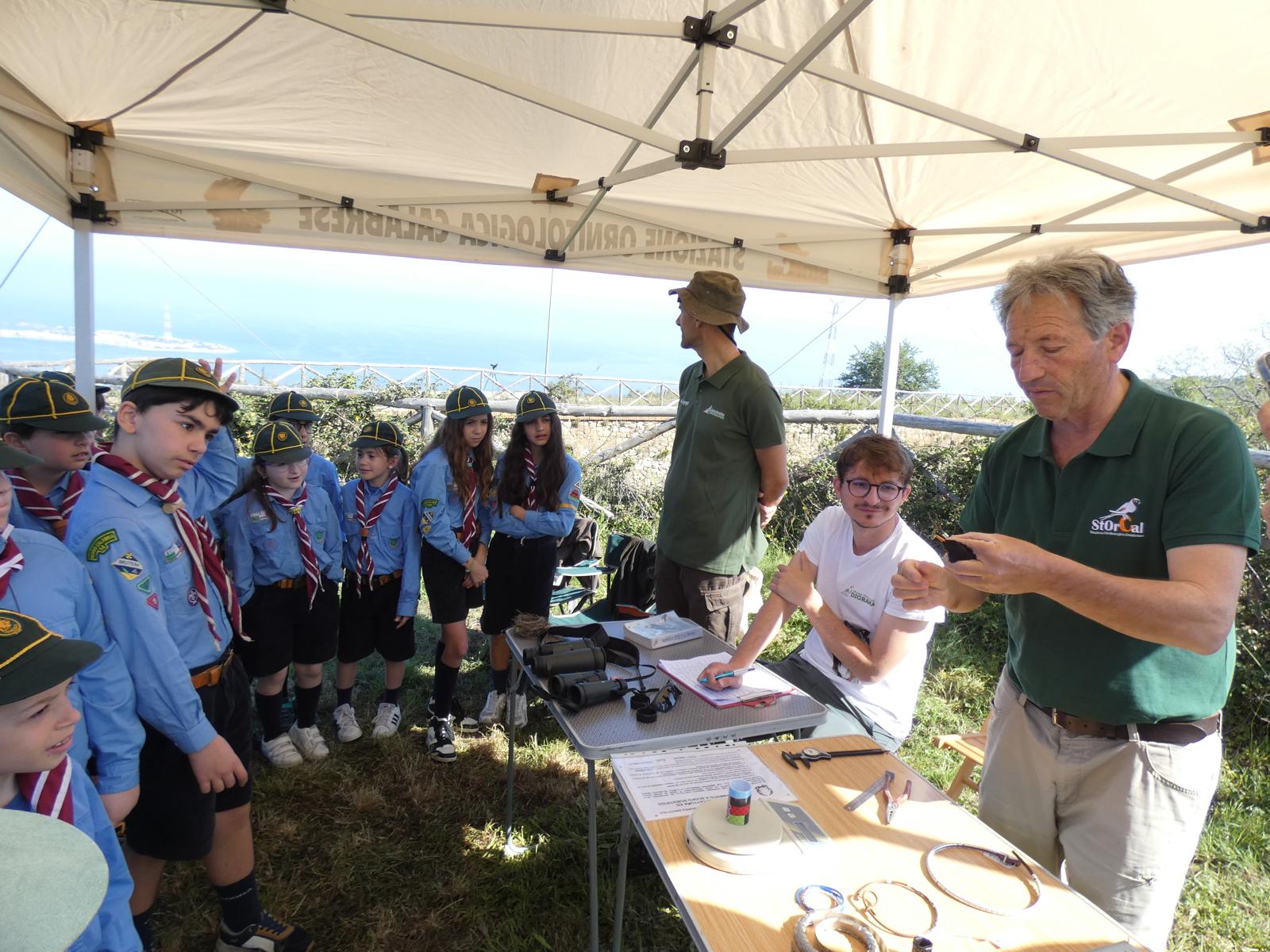
Bird ringing
Bird ringing at Punta Alice, where several of the region’s rare vagrants were first detected. Photo credit: Mario Pucci

Most of the other new entries tell a quieter story. Thirty-five of the 43 additions are accidental or vagrant birds, and they point to decades of more systematic fieldwork rather than to genuine range change. Targeted ringing at coastal stations such as Punta Alice (Crotone) and San Michele di Cetraro (Cosenza) has turned up Siberian warblers and flycatchers, among them Pallas’s Leaf Warbler, Dusky Warbler and Red-flanked Bluetail, that would otherwise pass unnoticed. In all, the vagrants recorded in Calabria come from Asia, Africa, northern Europe and even North America, a spread that makes the region a meeting point of separate migration systems.

The checklist also shows what is at stake for conservation. Of the 363 species, 125 are listed in Annex I of the EU Birds Directive, and national Red List categories are available for 230, including nine Critically Endangered.

Egyptian Vulture Neophron percnopterus
Egyptian Vulture, one of the Critically Endangered raptors still breeding in Calabria. Photo credit: Pierpaolo Storino

Most of the Critically Endangered birds depend on wetlands, tied to a small and fragmented network of coastal marshes. Among the region’s emblematic raptors is the Egyptian Vulture (Neophron percnopterus), still breeding in Calabria but represented in Italy by a small population with worrying fluctuations in the number of breeding birds, a reminder of how precarious the country’s cliff-nesting and scavenging raptors remain.

The full dataset is openly available on Zenodo, and the work is coordinated by the Stazione Ornitologica Calabrese (StOrCal), which brings the region’s observers together under shared standards. Much is still missing: the inland massifs of Pollino, Sila and Aspromonte remain under-surveyed, and breeding densities are poorly known for most species. The checklist gives that work a verifiable point to build on.

Original source:

Urso S, Martino G, Muscianese E, Policastrese M, Pucci M, Vena M, Storino P (2026) Updated checklist of the birds of Calabria (southern Italy). Biodiversity Data Journal 14: e195967. https://doi.org/10.3897/BDJ.14.e195967

Tiny habitant from Abrolhos bank (Brazil) sheds light on tropical Atlantic biogeography

For the first time, the bivalve mollusc Guyanella clenchi has been reported from Abrolhos Bank, Brazil.

For the first time, the bivalve mollusc Guyanella clenchi has been reported from Abrolhos Bank, Brazil. This almost unknown bivalve had previously been reported solely from the Caribbean region. Apart from being the southernmost record for the species, its presence also helps the experts to determine the way the marine fauna from the Caribbean interacts with its South American relatives.

The bivalve, which is a minute mollusc of only a few millimetres, had been known from Suriname, Guadeloupe, Colombia and French Guiana for nearly half a century. However, it is almost absent from the bibliographical registers and zoological collections.

Then, unexpectedly, during recent cruises to Abrolhos Bank (Bahia, Brazil), carried out as part of the Pro-Abrolhos project at Instituto Oceanografico da Universidade de Sao Paulo (IO-USP), enough specimens were retrieved to document the mysterious species from the Brazilian site.

The resulting study is published in the open-access journal Check List by Dr Barbara Louise Valentas-Romera, Museu de Zoologia da Universidade de Sao Paulo (MZSP), together with MSc Flavia Maria Pereira Costa and Dr Ana Maria Setubal Pires-Vanin, both affiliated to Instituto Oceanografico da Universidade de Sao Paulo (IO-USP).

According to the scientists, the discovery is very important for the understanding of the interaction between the mollusc faunas from the Caribbean and Southern Atlantic regions. While a mixture of these had long been known at both localities, serving as evidence that many species are indeed capable of crossing the geographical barriers between the two oceanic areas, it seems that no one had managed to answer how exactly this is happening. Now, the discovery of the tiny species shows that even small-sized molluscs have the ability to disperse so widely.

Additionally, the discovery of fresh specimens, complete with the body inside the shell, brings to light new information about the anatomy of the species itself, since the existing knowledge had only been derived from dry shells. Now, the secretive bivalve is to finally undergo molecular analyses.

The researchers behind the study explain:

“Despite its small size, the new occurrence of Guyanella clenchi brings new key data needed to understand the biogeography of the Caribbean and Southern Atlantic regions and improve our knowledge of the molluscs inhabiting the Brazilian coast, specifically the Abrolhos Bank, which is an important South Atlantic biodiversity hotspot.”

Abrolhos Bank is the largest and most species-rich coral reef in the Southern Atlantic. It is located in the Abrolhos Archipelago area and is part of the Abrolhos Marine National Park. Its most notable peculiarity is the giant coral structures shaped like mushrooms, locally known as “Chapeiroes”. A “chapeirao” can reach up to 25 metres in height and 50 metres in diameter. The region is considered the most biodiverse spot in the Southern Atlantic Ocean, providing home to several species that occur nowhere else.

Abrolhos Bank region (Bahia, Brazil).
Image by Dr Bárbara Louise Valentas-Romera.

###

Original source:

Valentas-Romera BL, Costa FMP, Pires-Vanin AMS (2019) Range extension of Guyanella clenchi (Altena, 1968) (Bivalvia, Lucinidae) with new records from Abrolhos Bank, Brazil. Check List15(4): 549-554. https://doi.org/10.15560/15.4.549

ScienceOpen indexes >1,000 articles from ARPHA-hosted journals RIO & Check List in a trial

Two scholarly journals published on ARPHA – Research Ideas and Outcomes (RIO Journal) and Check List – now have their articles freely available via the community-focused search and discovery platform ScienceOpen.

This new trial between the two high-tech innovators and Open Science proponents presents an important step forward to making research publications not only easier to find and access, but also more inviting to fellow scientists seeking new collaborations and platforms for voicing their ideas and expertise.

Currently, there are 168 and 948 article records fed to ScienceOpen straight from RIO and Check List respectively.

While the articles’ underlying data, such as author names, citations, keywords, journals and more, are automatically harvested and analyzed by ScienceOpen, so that research items can be easily interlinked, readers are encouraged to further provide context to the research items. The user-friendly intuitive interface invites them to add their comments, recommendations or open post-publication peer reviews, and even create their own topical collections regardless of affiliations and journals.

To make sure users land on the most relevant articles in what feels like the blink of an eye compared to traditional methods, ScienceOpen also accommodates an advanced multi-layer search engine relying on a total of 20 smart filters and six sorting parameters.

“We have long worked closely with ScienceOpen, as it only makes sense given our shared vision for the future of academia, so the present trial project happened very naturally,” says Prof. Lyubomir Penev, founder and CEO of ARPHA and its developer – scholarly publisher and technology provider Pensoft. “Nowadays, we are well aware that scientific findings are of little merit if ‘living’ in a vacuum. Therefore, we need research articles to be as discoverable as possible, and, no less importantly, to be open to feedback and further work.”

“We are thrilled to add this new content to the ScienceOpen as we have both strong researcher communities in zoology and in scholarly communications within our broadly interdisciplinary content. The ARPHA platform is a natural fit to deliver rich metadata to our discovery services and we are very much looking forward to working with their team,” says Stephanie Dawson, CEO of ScienceOpen.


About ScienceOpen:

ScienceOpen is an independent start-up company based in Berlin and Boston, which explores new ways to open up information for the scholarly community. It provides a freely accessible search and discovery platform that puts research in context. Smart filters, topical collections and expert input from the academic community help users to find the most relevant articles in their field and beyond.